
Ch. 14 - Ethers, Epoxides, and Thioethers
Wade - Organic Chemistry 9th Edition
Wade9th EditionOrganic ChemistryISBN: 9780135213728Not the one you use?Change textbook
Chapter 14, Problem 22

Mechanism of epoxidation of trans-but-2-ene to meso-butane-2,3-diol.
Propose mechanisms for the epoxidation and ring-opening steps of the epoxidation and hydrolysis of trans-but-2-ene shown above. Predict the product of the same reaction with cis-but-2-ene.

Verified step by step guidance
1
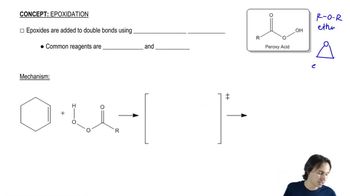
Step 1: Epoxidation of trans-but-2-ene occurs via reaction with a peracid (e.g., CH₃C(=O)OOH). The peracid transfers an oxygen atom to the double bond of trans-but-2-ene, forming an epoxide. The reaction proceeds through a concerted mechanism where the π-electrons of the double bond attack the electrophilic oxygen of the peracid, while the O-O bond of the peracid breaks and the proton is transferred to the carbonyl oxygen.
Step 2: The epoxide formed from trans-but-2-ene is a three-membered cyclic ether. This intermediate is highly strained and reactive, making it susceptible to ring-opening reactions under acidic conditions.
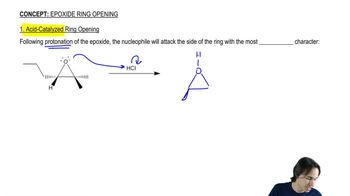
Step 3: In the ring-opening step, the epoxide reacts with water in the presence of an acid catalyst (H⁺). The acid protonates the oxygen atom of the epoxide, increasing its electrophilicity. Water then attacks one of the carbon atoms of the epoxide, leading to the formation of a diol. The attack occurs in an anti fashion, resulting in the trans addition of hydroxyl groups.
Step 4: For trans-but-2-ene, the product of the reaction is meso-butane-2,3-diol. This is because the anti addition of hydroxyl groups to the trans epoxide leads to a molecule with internal symmetry (meso compound).
Step 5: If cis-but-2-ene undergoes the same reaction, the epoxidation and subsequent ring-opening would result in a racemic mixture of enantiomers (R,R and S,S butane-2,3-diol). This is due to the anti addition of hydroxyl groups to the cis epoxide, which does not have internal symmetry.

Verified video answer for a similar problem:

This video solution was recommended by our tutors as helpful for the problem above.
Video duration:
12m
Was this helpful?

Key Concepts

Here are the essential concepts you must grasp in order to answer the question correctly.

Epoxidation

Epoxidation is a chemical reaction that converts alkenes into epoxides, which are three-membered cyclic ethers. This reaction typically involves the addition of an oxidizing agent, such as peracids, to the double bond of the alkene. In the case of trans-but-2-ene, the epoxidation leads to the formation of a cyclic ether that can undergo further reactions, such as ring-opening.
Recommended video:
Guided course
02:19
General properties of epoxidation.

Ring-Opening Mechanism

The ring-opening of an epoxide occurs when the strained three-membered ring reacts with a nucleophile, often in the presence of an acid or base. In acidic conditions, the epoxide is protonated, making it more electrophilic, and allowing nucleophiles, such as water, to attack the more substituted carbon. This results in the formation of diols, such as meso-butane-2,3-diol, which has specific stereochemical properties.
Recommended video:
Guided course
04:34
Acid-Catalyzed Epoxide Ring-Opening

Stereochemistry of Alkenes

Stereochemistry refers to the spatial arrangement of atoms in molecules and is crucial in understanding the reactivity and products of alkenes. The difference between cis and trans isomers affects the outcome of reactions, including epoxidation and subsequent hydrolysis. For example, while trans-but-2-ene yields meso-butane-2,3-diol, the reaction with cis-but-2-ene will produce a different stereoisomer due to the distinct spatial arrangement of substituents.
Recommended video:
1:38
Polymer Stereochemistry Concept 1
Related Practice
Textbook Question

The 2001 Nobel Prize in Chemistry was awarded to three organic chemists who have developed methods for catalytic asymmetric syntheses. An asymmetric (or enantioselective) synthesis is one that converts an achiral starting material into mostly one enantiomer of a chiral product. K. Barry Sharpless (The Scripps Research Institute) developed an asymmetric epoxidation of allylic alcohols that gives excellent chemical yields and greater than 90% enantiomeric excess.

The Sharpless epoxidation uses tert-butyl hydroperoxide, titanium(IV) isopropoxide, and a dialkyl tartrate ester as the reagents. The following epoxidation of geraniol is typical.

(a) Which of these reagents is most likely to be the actual oxidizing agent? That is, which reagent is reduced in the reaction? What is the likely function of the other reagents?

(b) When achiral reagents react to give a chiral product, that product is normally formed as a racemic mixture of enantiomers. How can the Sharpless epoxidation give just one nearly pure enantiomer of the product?

(c) Draw the other enantiomer of the product. What reagents would you use if you wanted to epoxidize geraniol to give this other enantiomer?

1
views
Textbook Question

Predict the major product when each reagent reacts with ethylene oxide.

(a) NaOCH2CH3 (sodium ethoxide)

(b) NaNH2 (sodium amide)

(c) NaSPh (sodium thiophenoxide)

1
views
Textbook Question

Show how you would accomplish the following transformations. Some of these examples require more than one step.

(e) 2-chlorohexan-1-ol → 1,2-epoxyhexane

1
views
Textbook Question

Show the rest of the mechanism for formation of the cyclized intermediate in Figure 14-6.

1
views
Textbook Question

Show how you would accomplish the following transformations. Some of these examples require more than one step.

(d) 5-chloropent-1-ene → 2-methyltetrahydrofuran 

2
views
Textbook Question

Cellosolve® is the trade name for 2-ethoxyethanol, a common industrial solvent. This compound is produced in chemical plants that use ethylene as their only organic feedstock. Show how you would accomplish this industrial process.

3
views