Ch. 14 - Ethers, Epoxides, and Thioethers
Wade - Organic Chemistry 9th Edition
Wade9th EditionOrganic ChemistryISBN: 9780135213728Not the one you use?Change textbook
Chapter 14, Problem 26a,b,c

Predict the major product when each reagent reacts with ethylene oxide.
(a) NaOCH2CH3 (sodium ethoxide)
(b) NaNH2 (sodium amide)
(c) NaSPh (sodium thiophenoxide)

Verified step by step guidance
1
Step 1: Ethylene oxide is a strained three-membered ring containing an oxygen atom. It is highly reactive toward nucleophiles due to ring strain and the electrophilic nature of the carbon atoms attached to the oxygen.
Step 2: In part (a), sodium ethoxide (NaOCH2CH3) acts as a nucleophile. The ethoxide ion (CH3CH2O−) attacks one of the electrophilic carbon atoms in ethylene oxide, opening the ring. This results in the formation of a product where the ethoxide group is attached to one of the carbons, and the other carbon bears a hydroxyl group.
Step 3: In part (b), sodium amide (NaNH2) provides the amide ion (NH2−) as a nucleophile. The amide ion attacks one of the electrophilic carbons in ethylene oxide, leading to ring opening. The product will have an amino group (NH2) attached to one carbon and a hydroxyl group on the other carbon.
Step 4: In part (c), sodium thiophenoxide (NaSPh) provides the thiophenoxide ion (PhS−) as a nucleophile. The thiophenoxide ion attacks one of the electrophilic carbons in ethylene oxide, opening the ring. The product will have a phenylthio group (PhS) attached to one carbon and a hydroxyl group on the other carbon.
Step 5: For all three reactions, the major product is determined by the nucleophile attacking the less sterically hindered carbon of ethylene oxide, resulting in ring opening and the formation of a two-carbon chain with the nucleophile and hydroxyl group attached to adjacent carbons.

Verified video answer for a similar problem:

This video solution was recommended by our tutors as helpful for the problem above.
Video duration:
8m
Was this helpful?

Key Concepts

Here are the essential concepts you must grasp in order to answer the question correctly.

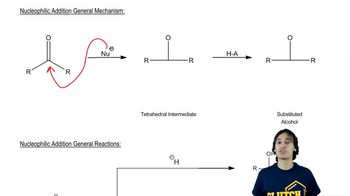
Nucleophilic Attack

Nucleophilic attack is a fundamental reaction mechanism in organic chemistry where a nucleophile donates an electron pair to an electrophile, forming a new bond. In the case of ethylene oxide, the oxygen atom in the epoxide is electrophilic due to the strain in the three-membered ring, making it susceptible to nucleophilic attack by reagents like sodium ethoxide, sodium amide, and sodium thiophenoxide.
Recommended video:
Guided course
08:27
Nucleophilic Addition

Ring Opening of Epoxides

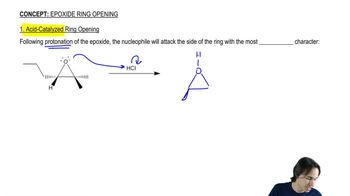
Epoxides, or oxiranes, are three-membered cyclic ethers that are highly reactive due to ring strain. When a nucleophile attacks an epoxide, it leads to the ring opening, resulting in the formation of a more stable product. The regioselectivity of the attack depends on the nature of the nucleophile and the conditions of the reaction, which is crucial for predicting the major product in the reactions with ethylene oxide.
Recommended video:
Guided course
04:34
Acid-Catalyzed Epoxide Ring-Opening

Stereochemistry of Products

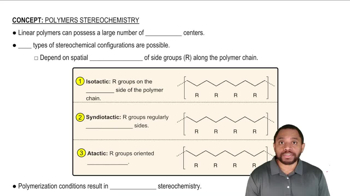
Stereochemistry refers to the spatial arrangement of atoms in molecules and how this affects their chemical behavior. In reactions involving epoxides, the stereochemistry of the nucleophile and the configuration of the starting material can influence the stereochemical outcome of the product. Understanding stereochemistry is essential for predicting the specific product formed when ethylene oxide reacts with different nucleophiles.
Recommended video:
1:38
Polymer Stereochemistry Concept 1