
Ch. 14 - Ethers, Epoxides, and Thioethers
Wade - Organic Chemistry 9th Edition
Wade9th EditionOrganic ChemistryISBN: 9780135213728Not the one you use?Change textbook
Chapter 14, Problem 41c

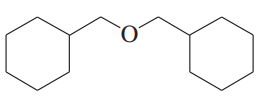
Both LiAlH4 and Grignard reagents react with carbonyl compounds to give alkoxide ion intermediates (that become protonated in an aqueous workup). Those alkoxides can react with 1° or methyl alkyl halides or tosylates to give ethers. Show how the following ethers can be formed in this two-step process. As starting materials you may use any reactants containing 7 carbons or fewer.
(c) Chemical structure of an ether featuring a central oxygen atom bonded to two carbon chains.

Verified step by step guidance
1
Step 1: Identify the ether structure. The given ether has two cyclohexyl groups connected by an oxygen atom. This suggests that the ether can be formed by combining two cyclohexyl-containing intermediates.
Step 2: Choose a suitable carbonyl compound as the starting material. Cyclohexanone (a ketone with a cyclohexyl group) is a good choice because it contains the cyclohexyl group and can react with a Grignard reagent or LiAlH4.
Step 3: Prepare the alkoxide intermediate. React cyclohexanone with a Grignard reagent (e.g., cyclohexyl magnesium bromide) or LiAlH4 to reduce the carbonyl group to an alkoxide ion. This step forms the cyclohexyl alkoxide intermediate.
Step 4: Perform the alkylation step. React the cyclohexyl alkoxide intermediate with a 1° or methyl alkyl halide or tosylate (e.g., cyclohexyl bromide or tosylate). This step forms the ether bond by substituting the halide or tosylate group with the alkoxide.
Step 5: Complete the synthesis. After the alkylation step, perform an aqueous workup to protonate any remaining intermediates and isolate the final ether product.

Verified video answer for a similar problem:

This video solution was recommended by our tutors as helpful for the problem above.
Video duration:
6m
Was this helpful?

Key Concepts

Here are the essential concepts you must grasp in order to answer the question correctly.

Carbonyl Compounds

Carbonyl compounds are organic molecules characterized by the presence of a carbonyl group (C=O). They include aldehydes and ketones, which are crucial in organic synthesis. In the context of the question, carbonyl compounds serve as the starting materials that react with reducing agents like LiAlH4 or Grignard reagents to form alkoxide intermediates.
Recommended video:
Guided course
01:40
Defining meso compounds.

Alkoxide Ions

Alkoxide ions are the conjugate bases of alcohols, formed when an alcohol loses a proton. They are strong nucleophiles and play a vital role in organic reactions, particularly in the formation of ethers. In the two-step process described, alkoxide ions are generated from the reduction of carbonyl compounds and subsequently react with alkyl halides to form ethers.
Recommended video:
3:39
Metal Ion Catalysis Concept 1

Ethers Formation

Ethers are organic compounds characterized by an oxygen atom bonded to two alkyl or aryl groups. The formation of ethers typically involves the reaction of alkoxide ions with primary or methyl alkyl halides through an SN2 mechanism. This process is essential in the synthesis of the ether shown in the question, where the appropriate starting materials must be selected to yield the desired product.
Recommended video:
Guided course
04:22
How to predict the products of Ether Cleavage.