Ch. 14 - Ethers, Epoxides, and Thioethers
Wade - Organic Chemistry 9th Edition
Wade9th EditionOrganic ChemistryISBN: 9780135213728Not the one you use?Change textbook
Chapter 14, Problem 41b

Both LiAlH4 and Grignard reagents react with carbonyl compounds to give alkoxide ion intermediates (that become protonated in an aqueous workup). Those alkoxides can react with 1° or methyl alkyl halides or tosylates to give ethers. Show how the following ethers can be formed in this two-step process. As starting materials you may use any reactants containing 7 carbons or fewer.
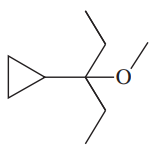
(b) Chemical structure of an ether, illustrating the connectivity of atoms in the Williamson Ether Synthesis process.

Verified step by step guidance
1
Step 1: Analyze the target ether structure. The ether shown has a cyclopropyl group attached to a tertiary carbon, which is also bonded to an ethyl group and a methoxy group. This suggests that the ether can be formed by reacting a tertiary alkoxide ion with a methyl alkyl halide or tosylate.
Step 2: Identify the carbonyl compound that can be used to generate the tertiary alkoxide ion. A suitable starting material would be a ketone with a cyclopropyl group and an ethyl group attached to the carbonyl carbon. This ketone can be reduced using a Grignard reagent or LiAlH4.
Step 3: Choose the Grignard reagent for the reduction step. To form the tertiary alkoxide, use methyl magnesium bromide (CH3MgBr) as the Grignard reagent. React the ketone with CH3MgBr to form the tertiary alkoxide ion.
Step 4: Perform the alkylation step. React the tertiary alkoxide ion with methyl iodide (CH3I) or methyl tosylate under basic conditions to form the desired ether. This step involves an SN2 reaction where the methyl group is transferred to the oxygen atom.
Step 5: Verify the carbon count and ensure all starting materials contain 7 carbons or fewer. The ketone, Grignard reagent, and alkyl halide/tosylate all meet this requirement, making them suitable starting materials for the synthesis.

Verified video answer for a similar problem:

This video solution was recommended by our tutors as helpful for the problem above.
Video duration:
7m
Was this helpful?

Key Concepts

Here are the essential concepts you must grasp in order to answer the question correctly.

Reduction of Carbonyl Compounds

LiAlH4 (lithium aluminum hydride) is a strong reducing agent that can reduce carbonyl compounds, such as aldehydes and ketones, to their corresponding alcohols. This reaction involves the nucleophilic attack of the hydride ion on the carbonyl carbon, leading to the formation of an alkoxide intermediate, which can be protonated in an aqueous workup to yield the alcohol.
Recommended video:
Guided course
01:40
Defining meso compounds.

Williamson Ether Synthesis

The Williamson Ether Synthesis is a method for forming ethers through the reaction of an alkoxide ion with a primary or methyl alkyl halide. The alkoxide acts as a nucleophile, attacking the electrophilic carbon of the alkyl halide, resulting in the formation of an ether. This reaction is particularly useful for synthesizing ethers from simple alcohols and halides.
Recommended video:
Guided course
03:50
The Mechanism of Williamson Ether Synthesis.

Alkyl Halides and Tosylates

Alkyl halides and tosylates are important substrates in organic synthesis, particularly in nucleophilic substitution reactions. Alkyl halides contain a carbon atom bonded to a halogen, while tosylates are derived from tosyl chloride and are better leaving groups. Both can react with alkoxide ions in the Williamson Ether Synthesis to form ethers, making them versatile in synthetic pathways.
Recommended video:
Guided course
01:52
How to name alkyl halides