Ch. 14 - Ethers, Epoxides, and Thioethers
Wade - Organic Chemistry 9th Edition
Wade9th EditionOrganic ChemistryISBN: 9780135213728Not the one you use?Change textbook
Chapter 14, Problem 37

(a) Show how you would synthesize the pure (R) enantiomer of 2-butyl methyl sulfide, starting with pure (R)-butan-2-ol and any reagents you need
(b) Show how you would synthesize the pure (S) enantiomer of the product, still starting with (R)-butan-2-ol and any reagents you need.

Verified step by step guidance
1
Step 1: Begin with the pure (R)-butan-2-ol as the starting material. The hydroxyl group (-OH) needs to be converted into a good leaving group to facilitate substitution. React (R)-butan-2-ol with a reagent like p-toluenesulfonyl chloride (TsCl) in the presence of a base such as pyridine to form the (R)-butan-2-yl tosylate. This step retains the stereochemistry of the starting material.
Step 2: To synthesize the (R)-enantiomer of 2-butyl methyl sulfide, perform a nucleophilic substitution reaction. React the (R)-butan-2-yl tosylate with sodium methyl sulfide (CH₃S⁻Na⁺). The methyl sulfide anion will attack the carbon attached to the tosylate group, displacing the tosylate and forming (R)-2-butyl methyl sulfide. This reaction proceeds via an SN2 mechanism, which inverts the stereochemistry. Since the starting material is (R)-butan-2-yl tosylate, the inversion results in the (R)-enantiomer of the product.
Step 3: To synthesize the (S)-enantiomer of 2-butyl methyl sulfide, you need to invert the stereochemistry of the starting material before proceeding with the substitution reaction. React (R)-butan-2-ol with a reagent like thionyl chloride (SOCl₂) in the presence of pyridine to form (S)-butan-2-yl chloride. This reaction proceeds via an SN2 mechanism, which inverts the stereochemistry of the alcohol to form the (S)-enantiomer of the alkyl chloride.
Step 4: Perform a nucleophilic substitution reaction to convert (S)-butan-2-yl chloride into (S)-2-butyl methyl sulfide. React (S)-butan-2-yl chloride with sodium methyl sulfide (CH₃S⁻Na⁺). The methyl sulfide anion will attack the carbon attached to the chloride group, displacing the chloride and forming (S)-2-butyl methyl sulfide. This reaction proceeds via an SN2 mechanism, which retains the stereochemistry of the starting material.
Step 5: Verify the stereochemistry of the products using techniques such as polarimetry or chiral chromatography to ensure that the desired (R)- and (S)-enantiomers of 2-butyl methyl sulfide have been synthesized.

Verified video answer for a similar problem:

This video solution was recommended by our tutors as helpful for the problem above.
Video duration:
6m
Was this helpful?

Key Concepts

Here are the essential concepts you must grasp in order to answer the question correctly.

Stereochemistry

Stereochemistry is the study of the spatial arrangement of atoms in molecules and how this affects their chemical behavior. In organic chemistry, understanding stereochemistry is crucial for distinguishing between enantiomers, which are molecules that are mirror images of each other. The (R) and (S) designations refer to the specific three-dimensional configurations of chiral centers in a molecule, which directly influence the properties and reactivity of the compounds.
Recommended video:
1:38
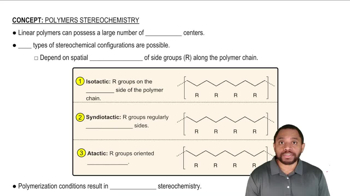
Polymer Stereochemistry Concept 1

Chiral Centers

A chiral center, often a carbon atom, is bonded to four different substituents, leading to non-superimposable mirror images. The presence of chiral centers in a molecule is what gives rise to enantiomers. In the synthesis of 2-butyl methyl sulfide, recognizing and manipulating these chiral centers is essential for producing the desired (R) or (S) enantiomer, as the configuration must be preserved or inverted appropriately during the synthesis process.
Recommended video:
Guided course
05:41
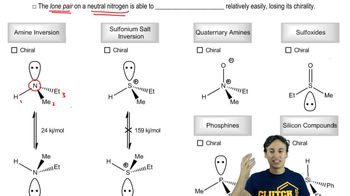
Understanding Other Chiral Atoms

Reagents and Reaction Mechanisms

The choice of reagents and understanding the reaction mechanisms are vital for synthesizing specific organic compounds. Different reagents can facilitate various types of reactions, such as nucleophilic substitutions or eliminations, which are crucial for forming or modifying chiral centers. In this synthesis, selecting the right reagents will determine whether the (R) or (S) enantiomer is produced, as well as the efficiency and yield of the overall reaction.
Recommended video:
Guided course
06:50
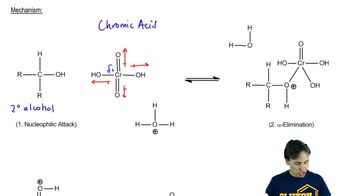
Jones Reagent Mechanism
Related Practice
Textbook Question

The following reaction resembles the acid-catalyzed cyclization of squalene oxide. Propose a mechanism for this reaction.

1
views

Textbook Question

Show how you would make the following ethers, using only simple alcohols and any needed reagents as your starting materials.

(a) 1-methoxybutane

(b) 2-ethoxy-2-methylpropane

(c) benzyl cyclopentyl ether

4
views
Textbook Question

Both LiAlH4 and Grignard reagents react with carbonyl compounds to give alkoxide ion intermediates (that become protonated in an aqueous workup). Those alkoxides can react with 1° or methyl alkyl halides or tosylates to give ethers. Show how the following ethers can be formed in this two-step process. As starting materials you may use any reactants containing 7 carbons or fewer.

(a)

1
views
Textbook Question

(A true story.) An inexperienced graduate student moved into a laboratory and began work. He needed some diethyl ether for a reaction, so he opened an old, rusty 1-gallon can marked 'ethyl ether' and found there was half a gallon left. To purify the ether, the student set up a distillation apparatus, started a careful distillation, and went to the stockroom for the other reagents he needed. While he was at the stockroom, the student heard a muffled "boom." He quickly returned to his lab to find a worker from another laboratory putting out a fire. Most of the distillation apparatus was embedded in the ceiling.

(a) Explain what probably happened.

(b) Explain how this near-disaster might have been prevented.

1
views
Textbook Question

Predict the products of the following reactions.

(m)

(n)

1
views
Textbook Question

Show how you would convert hex-1-ene to each of the following compounds. You may use any additional reagents and solvents you need.

(a) 2-methoxyhexane

(b) 1-methoxyhexane

(c) 1-methoxyhexan-2-ol

1
views