Ch.11 - Reactions of Alcohols
Wade - Organic Chemistry 9th Edition
Wade9th EditionOrganic ChemistryISBN: 9780135213728Not the one you use?Change textbook
Chapter 11, Problem 55c

Propose mechanisms for the following reactions. In most cases, more products are formed than are shown here. You only need to explain the formation of the products shown, however.
(c) Chemical reaction diagram showing dehydration of a compound with two hydroxyl groups, producing multiple products.

Verified step by step guidance
1
Step 1: Analyze the starting material and reaction conditions. The starting material is a diol (compound with two hydroxyl groups) on a bicyclic structure. The reaction conditions involve concentrated H₂SO₄ and heat, which typically promote dehydration reactions (loss of water) and rearrangements.
Step 2: Protonation of one of the hydroxyl groups occurs first. The acidic environment provided by H₂SO₄ protonates the hydroxyl group, making it a better leaving group. This leads to the formation of a carbocation intermediate after the departure of water.
Step 3: Consider carbocation rearrangements. The initial carbocation formed may undergo rearrangement to form a more stable carbocation. In this case, the bicyclic structure allows for hydride or alkyl shifts to stabilize the carbocation.
Step 4: Formation of the first product. The carbocation can lose a proton from an adjacent carbon to form a double bond, resulting in the first product, a bicyclic alkene.
Step 5: Formation of the other products. The carbocation can undergo further rearrangements or reactions. For example, a second dehydration step can lead to the formation of the conjugated diene product. Additionally, intramolecular nucleophilic attack by the remaining hydroxyl group can lead to the formation of the ketone product via ring closure.

Verified video answer for a similar problem:

This video solution was recommended by our tutors as helpful for the problem above.
Video duration:
8m
Was this helpful?

Key Concepts

Here are the essential concepts you must grasp in order to answer the question correctly.

Reaction Mechanisms

A reaction mechanism is a step-by-step description of how reactants transform into products during a chemical reaction. It outlines the sequence of elementary steps, including bond breaking and forming, and the intermediates involved. Understanding mechanisms is crucial for predicting the products of a reaction and for grasping the underlying principles of organic chemistry.
Recommended video:
Guided course
02:16
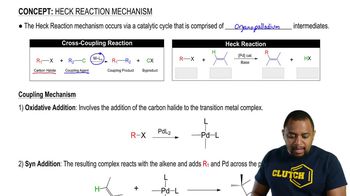
Heck Reaction Mechanism

Types of Organic Reactions

Organic reactions can be classified into several types, including substitution, addition, elimination, and rearrangement reactions. Each type has distinct characteristics and mechanisms. Recognizing the type of reaction helps in predicting the behavior of reactants and the nature of the products formed, which is essential for proposing accurate mechanisms.
Recommended video:
Guided course
07:37
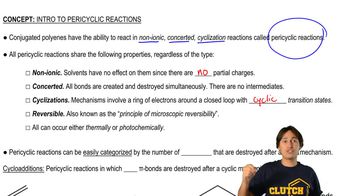
Properties and Types of Pericyclic Reactions

Intermediates and Transition States

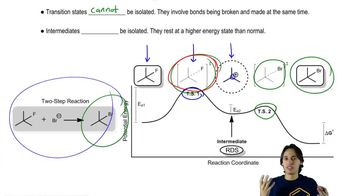
Intermediates are transient species formed during the course of a reaction, while transition states represent the highest energy state along the reaction pathway. Both are critical for understanding reaction mechanisms, as they provide insight into the stability and reactivity of different species. Analyzing these components helps in elucidating how products are formed from reactants.
Recommended video:
Guided course
06:55
Intermediates vs. Transition States