
Textbook Question
Explain why the acid-catalyzed condensation is a poor method for the synthesis of an unsymmetrical ether such as ethyl methyl ether, CH3CH2-O-CH3.
2
views

 Verified step by step guidance
 01:23
01:23
 05:09
05:09 05:58
05:58Explain why the acid-catalyzed condensation is a poor method for the synthesis of an unsymmetrical ether such as ethyl methyl ether, CH3CH2-O-CH3.
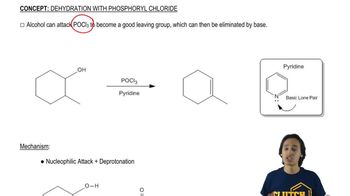
Some alcohols undergo rearrangement or other unwanted side reactions when they dehydrate in acid. Alcohols may be dehydrated under mildly basic conditions using phosphorus oxy-chloride (POCl3) in pyridine. The alcohol reacts with phosphorus oxychloride much like it reacts with tosyl chloride (Section 11-5), displacing a chloride ion from phosphorus to give an alkyl dichlorophosphate ester. The dichlorophosphate group is an outstanding leaving group. Pyridine reacts as a base with the dichlorophosphate ester to give an E2 elimination. Propose a mechanism for the dehydration of cyclohexanol by POCl3 in pyridine.
Contrast the mechanisms of the two preceding reactions, the dehydration and condensation of ethanol.
Two products are observed in the following reaction.
a. Suggest a mechanism to explain how these two products are formed.
b. Your mechanism for part (a) should be different from the usual mechanism of the reaction of SOCl2 with alcohols. Explain why the reaction follows a different mechanism in this case.
Give the structures of the products you would expect when each alcohol reacts with (1) HCl, ZnCl2; (2) HBr; (3) PBr3; (4) P/I2; and (5) SOCl2.
(a) butan-1-ol
(b) 2-methylbutan-2-ol
Suggest how you would convert trans-4-methylcyclohexanol to
a. trans-1-chloro-4-methylcyclohexane.
b. cis-1-chloro-4-methylcyclohexane.