
Textbook Question
Explain why the acid-catalyzed condensation is a poor method for the synthesis of an unsymmetrical ether such as ethyl methyl ether, CH3CH2-O-CH3.
2
views

 Verified step by step guidance
 01:23
01:23
 05:53
05:53 02:16
02:16Explain why the acid-catalyzed condensation is a poor method for the synthesis of an unsymmetrical ether such as ethyl methyl ether, CH3CH2-O-CH3.
Predict the products of the sulfuric acid-catalyzed dehydration of the following alcohols. When more than one product is expected, label the major and minor products.
(d) 1-isopropylcyclohexanol
(e) 2-methylcyclohexanol
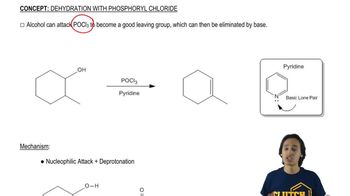
Some alcohols undergo rearrangement or other unwanted side reactions when they dehydrate in acid. Alcohols may be dehydrated under mildly basic conditions using phosphorus oxy-chloride (POCl3) in pyridine. The alcohol reacts with phosphorus oxychloride much like it reacts with tosyl chloride (Section 11-5), displacing a chloride ion from phosphorus to give an alkyl dichlorophosphate ester. The dichlorophosphate group is an outstanding leaving group. Pyridine reacts as a base with the dichlorophosphate ester to give an E2 elimination. Propose a mechanism for the dehydration of cyclohexanol by POCl3 in pyridine.
Propose a mechanism for each reaction.
(a)
Give the structures of the products you would expect when each alcohol reacts with (1) HCl, ZnCl2; (2) HBr; (3) PBr3; (4) P/I2; and (5) SOCl2.
(a) butan-1-ol
(b) 2-methylbutan-2-ol
Propose a mechanism for each reaction.
(c)