Ch.11 - Reactions of Alcohols
Wade - Organic Chemistry 9th Edition
Wade9th EditionOrganic ChemistryISBN: 9780135213728Not the one you use?Change textbook
Chapter 11, Problem 39a,b

Predict the major products of the following reactions, including stereochemistry where appropriate.
(a) (R)-butan-2-ol + TsCl in pyridine
(b) (S)-2-butyl tosylate + NaBr

Verified step by step guidance
1
Step 1: Analyze the first reaction (a). The reaction involves (R)-butan-2-ol reacting with tosyl chloride (TsCl) in pyridine. This is a tosylation reaction, where the hydroxyl group (-OH) of the alcohol is converted into a tosylate group (-OTs). The pyridine acts as a base to neutralize the HCl byproduct. The stereochemistry of the carbon center remains unchanged during this step, so the product will be (R)-2-butyl tosylate.
Step 2: Write the chemical equation for reaction (a). The structure of (R)-butan-2-ol is CH₃-CH(OH)-CH₂-CH₃, and the product will be CH₃-CH(OTs)-CH₂-CH₃. The stereochemistry at the chiral center (C2) remains (R).
Step 3: Analyze the second reaction (b). The reaction involves (S)-2-butyl tosylate reacting with NaBr. This is a nucleophilic substitution reaction (SN2 mechanism) because the tosylate group (-OTs) is a good leaving group, and bromide ion (Br⁻) is a strong nucleophile. In an SN2 reaction, the nucleophile attacks the electrophilic carbon from the opposite side of the leaving group, resulting in an inversion of configuration at the chiral center.
Step 4: Write the chemical equation for reaction (b). The structure of (S)-2-butyl tosylate is CH₃-CH(OTs)-CH₂-CH₃. The bromide ion (Br⁻) will replace the tosylate group, forming CH₃-CH(Br)-CH₂-CH₃. Due to the inversion of configuration, the product will have the (R)-configuration at the chiral center.
Step 5: Summarize the major products. For reaction (a), the product is (R)-2-butyl tosylate. For reaction (b), the product is (R)-2-bromobutane. Ensure to include stereochemistry in your final answer, as it is critical for understanding the outcome of these reactions.

Verified video answer for a similar problem:

This video solution was recommended by our tutors as helpful for the problem above.
Video duration:
3m
Was this helpful?

Key Concepts

Here are the essential concepts you must grasp in order to answer the question correctly.

Tosylation

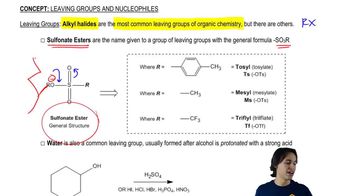
Tosylation is the process of converting an alcohol into a tosylate using tosyl chloride (TsCl) in the presence of a base like pyridine. This reaction transforms the alcohol into a better leaving group, facilitating subsequent nucleophilic substitution reactions. The resulting tosylate retains the stereochemistry of the original alcohol, which is crucial for predicting the products in further reactions.
Recommended video:
Guided course
07:22
The 3 important leaving groups to know.

Nucleophilic Substitution Reactions

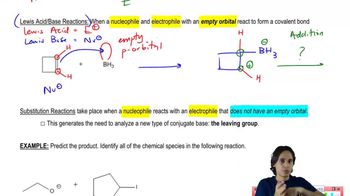
Nucleophilic substitution reactions involve the replacement of a leaving group by a nucleophile. In the case of the reaction between 2-butyl tosylate and NaBr, the bromide ion acts as the nucleophile, attacking the carbon atom bonded to the tosylate group. The mechanism can be either SN1 or SN2, depending on the substrate structure and conditions, which influences the stereochemistry of the product.
Recommended video:
Guided course
01:47
Nucleophiles and Electrophiles can react in Substitution Reactions.

Stereochemistry

Stereochemistry refers to the spatial arrangement of atoms in molecules and how this affects their chemical behavior. In reactions involving chiral centers, such as those with butan-2-ol and its derivatives, the stereochemistry of the reactants must be considered to predict the stereochemical outcome of the products. Understanding whether a reaction proceeds via an inversion of configuration or retention is essential for accurate product prediction.
Recommended video:
1:38
Polymer Stereochemistry Concept 1