Ch.11 - Reactions of Alcohols
Wade - Organic Chemistry 9th Edition
Wade9th EditionOrganic ChemistryISBN: 9780135213728Not the one you use?Change textbook
Chapter 11, Problem 38f

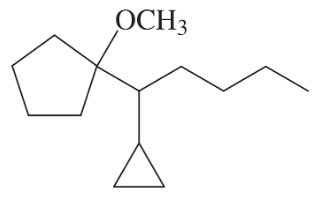
Develop syntheses for the following compounds. As starting materials, you may use cyclopentanol, alcohols containing no more than four carbon atoms, and any common reagents and solvents.
(f)

Verified step by step guidance
1
Step 1: Analyze the target molecule. The compound contains a cyclopentane ring, a methoxy group (-OCH₃) attached to a tertiary carbon, a cyclopropyl group, and a butyl chain. This suggests the need for multiple synthetic steps involving functional group transformations and carbon-carbon bond formation.
Step 2: Start with cyclopentanol as the base structure. Convert cyclopentanol to cyclopentyl bromide using PBr₃ (phosphorus tribromide) to introduce a good leaving group for subsequent reactions.
Step 3: Perform a Grignard reaction to introduce the tertiary carbon center. React cyclopentyl bromide with magnesium in dry ether to form cyclopentyl magnesium bromide. Then, react this Grignard reagent with acetone to form a tertiary alcohol.
Step 4: Convert the tertiary alcohol to the methoxy group (-OCH₃). Use methyl iodide (CH₃I) and a base such as NaH to perform a Williamson ether synthesis, replacing the hydroxyl group with the methoxy group.
Step 5: Introduce the cyclopropyl and butyl groups. Use alkyl halides (e.g., cyclopropyl bromide and butyl bromide) in successive alkylation reactions with the tertiary carbon center, ensuring proper regioselectivity and steric control.

Verified video answer for a similar problem:

This video solution was recommended by our tutors as helpful for the problem above.
Video duration:
4m
Was this helpful?

Key Concepts

Here are the essential concepts you must grasp in order to answer the question correctly.

Synthesis of Organic Compounds

Organic synthesis involves the construction of complex organic molecules from simpler ones. This process often requires a series of chemical reactions, including functional group transformations, to achieve the desired structure. Understanding the reactivity of different functional groups and the mechanisms of these reactions is crucial for developing effective synthetic pathways.
Recommended video:
Guided course
01:40
Defining meso compounds.

Functional Groups

Functional groups are specific groups of atoms within molecules that are responsible for the characteristic chemical reactions of those molecules. In the context of the given question, recognizing the functional groups present in the target compound, such as ethers or alcohols, is essential for determining appropriate starting materials and reagents for synthesis.
Recommended video:
Guided course
02:36
Identifying Functional Groups

Reagents and Solvents in Organic Reactions

Reagents are substances used to cause a chemical reaction, while solvents are the mediums in which reactions occur. The choice of reagents and solvents can significantly influence the outcome of a reaction, including yield and selectivity. Familiarity with common reagents and their roles in organic synthesis is vital for successfully developing synthetic routes.
Recommended video:
Guided course
02:26
General format of reactions and how to interpret solvents.