Ch.10 - Structure and Synthesis of Alcohols
Wade - Organic Chemistry 9th Edition
Wade9th EditionOrganic ChemistryISBN: 9780135213728Not the one you use?Change textbook
Chapter 10, Problem 39e

Show how you would use Grignard syntheses to prepare the following alcohol from the indicated starting material and any other necessary reagents.
(e) benzyl alcohol (Ph–CH2–OH) from bromobenzene (Ph–Br)

Verified step by step guidance
1
Step 1: Begin by preparing the Grignard reagent from the starting material, bromobenzene (Ph-Br). React bromobenzene with magnesium (Mg) in an anhydrous ether solvent (e.g., diethyl ether) to form phenylmagnesium bromide (Ph-MgBr). This reaction is represented as: Ph-Br + Mg → Ph-MgBr.
Step 2: To introduce the -CH2OH group, react the Grignard reagent (Ph-MgBr) with formaldehyde (HCHO). Formaldehyde is the simplest aldehyde and will add a single carbon to the benzene ring. The reaction proceeds via nucleophilic addition, where the carbon in Ph-MgBr attacks the carbonyl carbon of formaldehyde.
Step 3: After the nucleophilic addition, the intermediate formed is a magnesium alkoxide. This intermediate has the structure Ph-CH2-O-MgBr.
Step 4: Perform an acidic workup by adding a dilute acid (e.g., HCl or H2SO4) to the reaction mixture. This step protonates the alkoxide group (-O-MgBr) to form the desired alcohol, benzyl alcohol (Ph-CH2-OH).
Step 5: Verify the product structure and ensure that the reaction conditions are anhydrous during the Grignard reagent preparation, as Grignard reagents are highly reactive with water and will decompose if exposed to moisture.

Verified video answer for a similar problem:

This video solution was recommended by our tutors as helpful for the problem above.
Video duration:
3m
Was this helpful?

Key Concepts

Here are the essential concepts you must grasp in order to answer the question correctly.

Grignard Reagents

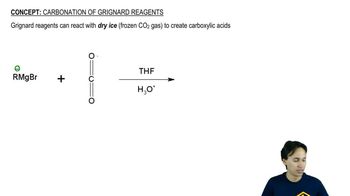
Grignard reagents are organomagnesium compounds, typically represented as R-MgX, where R is an organic group and X is a halogen. They are highly reactive and can act as nucleophiles, allowing them to react with electrophiles to form new carbon-carbon bonds. In the context of synthesizing alcohols, Grignard reagents can react with carbonyl compounds to yield alcohols after hydrolysis.
Recommended video:
Guided course
02:12
Carbonation of Grignard Reagents

Nucleophilic Substitution

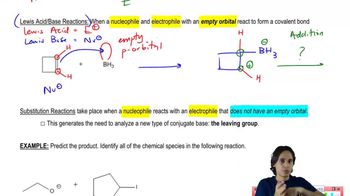
Nucleophilic substitution is a fundamental reaction mechanism in organic chemistry where a nucleophile attacks an electrophile, resulting in the replacement of a leaving group. In the case of Grignard synthesis, the nucleophilic Grignard reagent attacks the electrophilic carbon in a carbon halide, leading to the formation of a new carbon-carbon bond. This mechanism is crucial for constructing complex organic molecules.
Recommended video:
Guided course
01:47
Nucleophiles and Electrophiles can react in Substitution Reactions.

Hydrolysis of Grignard Reagents

Hydrolysis of Grignard reagents is the process where the Grignard reagent reacts with water or an alcohol to form the corresponding alcohol and magnesium hydroxide halide. This step is essential after the nucleophilic attack, as it converts the intermediate alkoxide formed during the reaction into a stable alcohol. Understanding this step is vital for completing the synthesis of the desired alcohol product.
Recommended video:
Guided course
02:12
Carbonation of Grignard Reagents