Ch.10 - Structure and Synthesis of Alcohols
Wade - Organic Chemistry 9th Edition
Wade9th EditionOrganic ChemistryISBN: 9780135213728Not the one you use?Change textbook
Chapter 10, Problem 38d

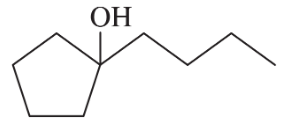
Show how you would synthesize the following alcohol from appropriate alkene.
(d)

Verified step by step guidance
1
Analyze the target molecule: The alcohol group (-OH) is attached to a secondary carbon. This suggests that the synthesis will involve the Markovnikov addition of water to an alkene.
Identify the appropriate alkene: The target alcohol can be synthesized from an alkene where the double bond is located between the secondary carbon (where the -OH group is attached) and the adjacent carbon. In this case, the alkene would be cyclopentylpropene.
Select the reaction conditions: To achieve Markovnikov addition of water, use an acid-catalyzed hydration reaction. This typically involves using dilute sulfuric acid (H₂SO₄) and water (H₂O) as reagents.
Describe the mechanism: The alkene undergoes protonation by H⁺ from the acid, forming a carbocation intermediate at the more stable secondary carbon. Water then attacks the carbocation, followed by deprotonation to yield the alcohol.
Verify the product: Ensure that the alcohol formed matches the structure of the target molecule, with the -OH group attached to the secondary carbon and the rest of the carbon skeleton intact.

Verified video answer for a similar problem:

This video solution was recommended by our tutors as helpful for the problem above.
Video duration:
2m
Was this helpful?

Key Concepts

Here are the essential concepts you must grasp in order to answer the question correctly.

Alkene Reactivity

Alkenes are unsaturated hydrocarbons characterized by at least one carbon-carbon double bond. Their reactivity is primarily due to this double bond, which can undergo various reactions such as electrophilic addition. Understanding the nature of the alkene and the conditions under which it reacts is crucial for synthesizing alcohols from alkenes.
Recommended video:
2:09
Alkene Metathesis Concept 1

Hydroboration-Oxidation

The hydroboration-oxidation reaction is a two-step process used to convert alkenes into alcohols. In the first step, an alkene reacts with borane (BH3) to form an organoborane intermediate, which is then oxidized in the second step using hydrogen peroxide (H2O2) and a base. This method provides a syn-addition of water across the double bond, resulting in the formation of alcohols with anti-Markovnikov selectivity.
Recommended video:
Guided course
06:38
General properties of hydroboration-oxidation.

Markovnikov's Rule

Markovnikov's Rule states that in the addition of HX (where X is a halogen or hydroxyl group) to an alkene, the hydrogen atom will attach to the carbon with the greater number of hydrogen atoms already attached. This principle is essential for predicting the outcome of reactions involving alkenes and helps in determining the structure of the resulting alcohol when synthesizing from a specific alkene.
Recommended video:
Guided course
03:54
The 18 and 16 Electron Rule