Ch.10 - Structure and Synthesis of Alcohols
Wade - Organic Chemistry 9th Edition
Wade9th EditionOrganic ChemistryISBN: 9780135213728Not the one you use?Change textbook
Chapter 10, Problem 36k,l

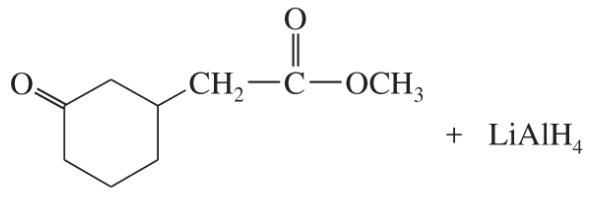
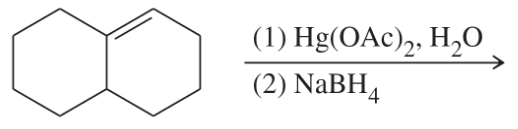
Draw the organic products you would expect to isolate from the following reactions (after hydrolysis).
(k)
(l)

Verified step by step guidance
1
Step 1: Analyze the first reaction. The compound contains two functional groups: a ketone and an ester. Lithium aluminum hydride (LiAlH4) is a strong reducing agent that reduces both ketones and esters to their corresponding alcohols.
Step 2: For the ketone group (C=O), LiAlH4 will reduce it to a secondary alcohol. The oxygen atom will gain a hydrogen atom, forming an -OH group attached to the carbon.
Step 3: For the ester group (COOCH3), LiAlH4 will reduce it to a primary alcohol. The ester bond will be cleaved, and the oxygen atom will gain hydrogen atoms, forming an -OH group. The methyl group (CH3) will also be converted into methanol (CH3OH).
Step 4: Analyze the second reaction. The compound is a bicyclic alkene undergoing oxymercuration-demercuration. In the first step, Hg(OAc)2 and H2O add a hydroxyl group (-OH) to the more substituted carbon of the double bond, following Markovnikov's rule.
Step 5: In the second step, NaBH4 reduces the intermediate formed in the first step, removing the mercury group and leaving the hydroxyl group (-OH) on the more substituted carbon. The final product is an alcohol formed at the more substituted position of the double bond.

Verified video answer for a similar problem:

This video solution was recommended by our tutors as helpful for the problem above.
Video duration:
4m
Was this helpful?

Key Concepts

Here are the essential concepts you must grasp in order to answer the question correctly.

Hydrolysis

Hydrolysis is a chemical reaction involving the breaking of a bond in a molecule using water. In organic chemistry, it often refers to the conversion of esters, amides, or other functional groups into their corresponding acids and alcohols or amines. Understanding hydrolysis is crucial for predicting the products of reactions, especially when water is involved in the reaction mechanism.
Recommended video:
1:00
Hydrolysis of Thioesters Concept 2

Reaction Mechanisms

A reaction mechanism is a step-by-step description of how a chemical reaction occurs, detailing the bonds that break and form. In organic chemistry, mechanisms help explain the pathways through which reactants transform into products, including intermediates and transition states. Familiarity with common mechanisms, such as nucleophilic substitution or elimination, is essential for predicting the outcomes of reactions.
Recommended video:
Guided course
02:16
Heck Reaction Mechanism

Functional Groups

Functional groups are specific groups of atoms within molecules that are responsible for the characteristic chemical reactions of those molecules. In organic chemistry, identifying functional groups such as alcohols, carboxylic acids, and amines is vital for understanding reactivity and predicting the products of chemical reactions. Each functional group has unique properties and reactivity patterns that influence the overall behavior of organic compounds.
Recommended video:
Guided course
02:36
Identifying Functional Groups