Ch.10 - Structure and Synthesis of Alcohols
Wade - Organic Chemistry 9th Edition
Wade9th EditionOrganic ChemistryISBN: 9780135213728Not the one you use?Change textbook
Chapter 10, Problem 36m

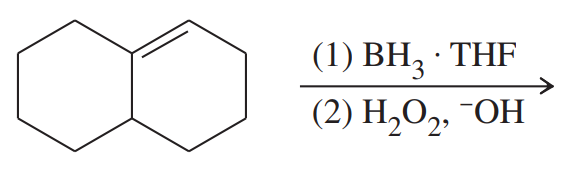
Draw the organic products you would expect to isolate from the following reactions (after hydrolysis).
(m) Chemical structure showing a bicyclic compound with hydroboration and hydrolysis reaction conditions listed.

Verified step by step guidance
1
Step 1: Identify the reaction type. The given reaction involves hydroboration-oxidation, which is a two-step process used to convert alkenes into alcohols. The reagents are BH₃·THF (borane in tetrahydrofuran) followed by H₂O₂ and OH⁻ (hydrogen peroxide and hydroxide).
Step 2: Understand the regioselectivity of hydroboration. Hydroboration-oxidation follows anti-Markovnikov addition, meaning the hydroxyl group (-OH) will add to the less substituted carbon of the double bond.
Step 3: Analyze the structure of the starting material. The starting material is a bicyclic compound with a double bond in one of the rings. The double bond is the reactive site for hydroboration.
Step 4: Predict the intermediate formed after the first step. In the hydroboration step, BH₃ adds across the double bond, with the boron atom attaching to the less substituted carbon and the hydrogen atom attaching to the more substituted carbon.
Step 5: Predict the final product after oxidation. In the oxidation step, the boron atom is replaced by a hydroxyl group (-OH), resulting in the formation of an alcohol. The hydroxyl group will be attached to the less substituted carbon of the original double bond.

Verified video answer for a similar problem:

This video solution was recommended by our tutors as helpful for the problem above.
Video duration:
2m
Was this helpful?

Key Concepts

Here are the essential concepts you must grasp in order to answer the question correctly.

Hydrolysis

Hydrolysis is a chemical reaction involving the breaking of a bond in a molecule using water. In organic chemistry, it often refers to the reaction of a compound with water to form two or more products. This process is crucial for understanding how certain organic compounds, such as esters or amides, can be converted into their corresponding acids and alcohols or amines, respectively.
Recommended video:
1:00
Hydrolysis of Thioesters Concept 2

Reaction Mechanisms

Understanding reaction mechanisms is essential for predicting the products of organic reactions. A reaction mechanism outlines the step-by-step process by which reactants are converted into products, including the formation and breaking of bonds. Familiarity with common mechanisms, such as nucleophilic substitution or elimination, helps in anticipating the structure of the final products after hydrolysis.
Recommended video:
Guided course
02:16
Heck Reaction Mechanism

Functional Groups

Functional groups are specific groups of atoms within molecules that are responsible for the characteristic chemical reactions of those molecules. Recognizing functional groups, such as alcohols, carboxylic acids, and amines, is vital for predicting the outcomes of organic reactions. The nature of the functional groups involved in the reaction will significantly influence the products formed after hydrolysis.
Recommended video:
Guided course
02:36
Identifying Functional Groups