
Ch. 2 - Acids and Bases; Functional Groups
Wade - Organic Chemistry 9th Edition
Wade9th EditionOrganic ChemistryISBN: 9780135213728Not the one you use?Change textbook
Chapter 2, Problem 13g,h,i

Write equations for the following acid–base reactions. Label the conjugate acids and bases, and show any inductive stabilization. Predict whether the equilibrium favors the reactants or products. Try to do this without using a table of pKa values, but if you need a hint, you can consult Appendix 4.
g. NaOCH2CH3 + Cl2CHCH2OH
h. H2Se + NaNH2
i. CH3CHFCOOH + FCH2CH2COO

Verified step by step guidance
1
Step 1: Identify the acid and base in each reaction. For reaction (g), NaOCH2CH3 is the base and Cl2CHCH2OH is the acid. For reaction (h), H2Se is the acid and NaNH2 is the base. For reaction (i), CH3CHFCOOH is the acid and FCH2CH2COO- is the base.
Step 2: Write the chemical equation for each reaction. For reaction (g), the equation is: NaOCH2CH3 + Cl2CHCH2OH → HOCH2CH3 + Cl2CHCH2ONa. For reaction (h), the equation is: H2Se + NaNH2 → HSe- + NH3. For reaction (i), the equation is: CH3CHFCOOH + FCH2CH2COO- → CH3CHFCOO- + FCH2CH2COOH.
Step 3: Label the conjugate acids and bases. In reaction (g), HOCH2CH3 is the conjugate acid and Cl2CHCH2ONa is the conjugate base. In reaction (h), HSe- is the conjugate base and NH3 is the conjugate acid. In reaction (i), CH3CHFCOO- is the conjugate base and FCH2CH2COOH is the conjugate acid.
Step 4: Consider inductive effects for stabilization. In reaction (g), the Cl groups on Cl2CHCH2OH can stabilize the conjugate base Cl2CHCH2O- through inductive effects. In reaction (i), the electronegative F atom in CH3CHFCOOH can stabilize the conjugate base CH3CHFCOO-.
Step 5: Predict the direction of equilibrium. Consider the stability of the conjugate bases and acids. Generally, the equilibrium will favor the side with the more stable conjugate base and acid. For example, in reaction (g), if Cl2CHCH2O- is more stable due to inductive effects, the equilibrium may favor the products.

Verified video answer for a similar problem:

This video solution was recommended by our tutors as helpful for the problem above.
Video duration:
8m
Was this helpful?

Key Concepts

Here are the essential concepts you must grasp in order to answer the question correctly.

Acid-Base Reaction Mechanism

Acid-base reactions involve the transfer of protons (H+) between reactants. The acid donates a proton, becoming its conjugate base, while the base accepts a proton, forming its conjugate acid. Understanding the mechanism helps predict the direction of equilibrium based on the relative strengths of acids and bases involved.
Recommended video:
Guided course
02:49
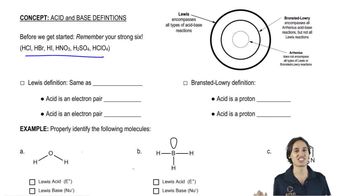
The Lewis definition of acids and bases.

Conjugate Acid-Base Pairs

In an acid-base reaction, each acid has a corresponding conjugate base, and each base has a conjugate acid. Identifying these pairs is crucial for labeling the products and reactants correctly. The conjugate acid-base pair concept helps in understanding the stability and reactivity of the species involved in the reaction.
Recommended video:
2:56
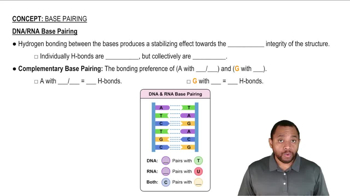
Base Pairing Concept 1

Inductive Effect and Stabilization

The inductive effect refers to the electron-withdrawing or electron-donating influence of substituents through sigma bonds, affecting the stability of ions. In acid-base reactions, inductive stabilization can influence the equilibrium position by stabilizing the conjugate base or acid, thus affecting the acidity or basicity of the molecules involved.
Recommended video:
Guided course
01:47
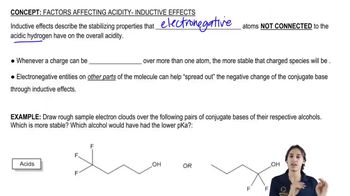
Understanding the Inductive Effect.
Related Practice
Textbook Question

Like nitrogen and carbon, oxygen also shows this same hybridization effect on acidity. Both of the following compounds can lose a proton from a positively charged oxygen with three bonds to give a conjugate base containing a neutral oxygen with two bonds. One of these structures has pKa = −2.4, while the other has pKa = −8.0.

a. Show the reaction of each compound with water.

b. Match each structure with its pKa, and explain your choice.

Textbook Question

Rank the following acids in decreasing order of their acid strength. In each case, explain why the previous compound should be a stronger acid than the one that follows it.

1
views
Textbook Question

Write equations for the following acid–base reactions. Label the conjugate acids and bases, and show any inductive stabilization. Predict whether the equilibrium favors the reactants or products. Try to do this without using a table of pKa values, but if you need a hint, you can consult Appendix 4.

j. CF3CH2O + FCH2CH2OH

1
views
Textbook Question

Write equations for the following acid–base reactions. Label the conjugate acids and bases, and show any inductive stabilization. Predict whether the equilibrium favors the reactants or products. Try to do this without using a table of pKa values, but if you need a hint, you can consult Appendix 4.

a. CH3CH2OH + CH3NH

b. F3CCOONa + Br3C—COOH

c. CH3OH + H2SO4

Textbook Question

For each of the following reactions, suggest which solvent(s) would be compatible with the acids and bases involved. (We will ignore any other possible reactions for now.) Your choices of solvents are pentane, diethyl ether, ethanol, water, and ammonia. Refer to Appendix 4 for any needed values of pKa, or estimate them. 

c.

d.

1
views
Textbook Question

For each of the following reactions, suggest which solvent(s) would be compatible with the acids and bases involved. (We will ignore any other possible reactions for now.) Your choices of solvents are pentane, diethyl ether, ethanol, water, and ammonia. Refer to Appendix 4 for any needed values of pKa, or estimate them.

a. CH3Li + H—C≡C—H → CH4 + H—C≡CLi

b. CH3Li + (CH3)3C—OH → CH4 + (CH3)3C—OLi

2
views