Ch. 2 - Acids and Bases; Functional Groups
Wade - Organic Chemistry 9th Edition
Wade9th EditionOrganic ChemistryISBN: 9780135213728Not the one you use?Change textbook
Chapter 2, Problem 14a

Rank the following acids in decreasing order of their acid strength. In each case, explain why the previous compound should be a stronger acid than the one that follows it.

Verified step by step guidance
1
Identify the substituents on each acid and their positions relative to the carboxylic acid group. The acids are 2-chloropropanoic acid, 2-bromopropanoic acid, 2,2-dichloropropanoic acid, and 3-bromopropanoic acid.
Understand that the acidity of carboxylic acids is influenced by the electron-withdrawing ability of substituents. Halogens like chlorine and bromine are electron-withdrawing due to their electronegativity.
Recognize that the closer the electron-withdrawing group is to the carboxylic acid group, the stronger the acid. This is due to the inductive effect, which stabilizes the negative charge on the conjugate base.
Compare the electronegativity of chlorine and bromine. Chlorine is more electronegative than bromine, making it a stronger electron-withdrawing group, thus increasing acidity.
Rank the acids based on the number and position of electron-withdrawing groups: 2,2-dichloropropanoic acid (strongest due to two chlorines), 2-chloropropanoic acid, 2-bromopropanoic acid, and 3-bromopropanoic acid (weakest due to the bromine being further from the carboxylic group).

Verified video answer for a similar problem:

This video solution was recommended by our tutors as helpful for the problem above.
Video duration:
4m
Was this helpful?

Key Concepts

Here are the essential concepts you must grasp in order to answer the question correctly.

Acid Strength and Electronegativity

The strength of an acid is influenced by the electronegativity of the atoms attached to the acidic hydrogen. More electronegative atoms stabilize the negative charge on the conjugate base after deprotonation, making the acid stronger. For example, chlorine is more electronegative than bromine, which suggests that acids with chlorine will generally be stronger than those with bromine.
Recommended video:
Guided course
1:47
Electronegativity

Resonance Stabilization

Resonance stabilization occurs when a molecule can distribute its charge over multiple atoms through delocalization. In the context of acids, if the conjugate base can stabilize the negative charge through resonance, the acid will be stronger. The presence of multiple electronegative atoms can enhance this effect, leading to increased acid strength.
Recommended video:
Guided course
03:43
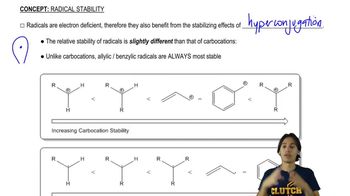
The radical stability trend.

Inductive Effect

The inductive effect refers to the electron-withdrawing or electron-donating effects of substituents on a molecule. Electron-withdrawing groups, such as halogens, can increase acid strength by stabilizing the negative charge on the conjugate base. The more electronegative the substituent, the stronger the inductive effect, which can lead to a ranking of acid strengths based on the substituents present.
Recommended video:
Guided course
01:47
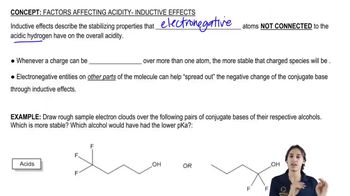
Understanding the Inductive Effect.
Related Practice
Textbook Question

Consider the type of orbitals involved, and rank the following nitrogen compounds in order of decreasing basicity. 2. Rank the conjugate acids in order of increasing acidity. (Hint: These two orders should be the same!)


Textbook Question

Like nitrogen and carbon, oxygen also shows this same hybridization effect on acidity. Both of the following compounds can lose a proton from a positively charged oxygen with three bonds to give a conjugate base containing a neutral oxygen with two bonds. One of these structures has pKa = −2.4, while the other has pKa = −8.0.

a. Show the reaction of each compound with water.

b. Match each structure with its pKa, and explain your choice.

Textbook Question

Write equations for the following acid–base reactions. Label the conjugate acids and bases, and show any inductive stabilization. Predict whether the equilibrium favors the reactants or products. Try to do this without using a table of pKa values, but if you need a hint, you can consult Appendix 4.

g. NaOCH2CH3 + Cl2CHCH2OH

h. H2Se + NaNH2

i. CH3CHFCOOH + FCH2CH2COO

2
views
Textbook Question

Give the structures of their conjugate acids, and estimate their pKas from similar compounds in Appendix 4.

Textbook Question

Write equations for the following acid–base reactions. Label the conjugate acids and bases, and show any inductive stabilization. Predict whether the equilibrium favors the reactants or products. Try to do this without using a table of pKa values, but if you need a hint, you can consult Appendix 4.

j. CF3CH2O + FCH2CH2OH

1
views
Textbook Question

Write equations for the following acid–base reactions. Label the conjugate acids and bases, and show any inductive stabilization. Predict whether the equilibrium favors the reactants or products. Try to do this without using a table of pKa values, but if you need a hint, you can consult Appendix 4.

a. CH3CH2OH + CH3NH

b. F3CCOONa + Br3C—COOH

c. CH3OH + H2SO4