Ch. 2 - Acids and Bases; Functional Groups
Wade - Organic Chemistry 9th Edition
Wade9th EditionOrganic ChemistryISBN: 9780135213728Not the one you use?Change textbook
Chapter 2, Problem 54a,b

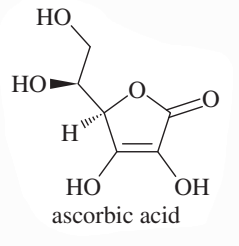
The pKa of ascorbic acid (vitamin C, page 55) is 4.17, showing that it is slightly more acidic than acetic acid (CH3COOH, pKa 4.74).
Structural formula of ascorbic acid (vitamin C) showing hydroxyl groups for acidity comparison.
a. Show the four different conjugate bases that would be formed by deprotonation of the four different OH groups in ascorbic acid.
b. Compare the stabilities of these four conjugate bases, and predict which OH group of ascorbic acid is the most acidic.

Verified step by step guidance
1
Identify the four hydroxyl (OH) groups in the structure of ascorbic acid. These are the groups that can potentially lose a proton to form conjugate bases.
For each OH group, consider the deprotonation process: remove the hydrogen ion (H⁺) from the OH group, leaving behind an oxygen atom with a negative charge (O⁻). This forms the conjugate base.
Examine the stability of each conjugate base formed. Stability can be influenced by factors such as resonance, inductive effects, and the electronegativity of surrounding atoms. Resonance stabilization is particularly important in organic chemistry.
Compare the conjugate bases: The conjugate base that is most stabilized by resonance or other effects will correspond to the most acidic OH group. Look for conjugate bases where the negative charge can be delocalized over multiple atoms.
Predict the most acidic OH group: Based on the stability analysis, determine which OH group is most likely to lose a proton. The most acidic OH group will be the one whose conjugate base is most stable.

Verified video answer for a similar problem:

This video solution was recommended by our tutors as helpful for the problem above.
Video duration:
9m
Was this helpful?

Key Concepts

Here are the essential concepts you must grasp in order to answer the question correctly.

pKa and Acidity

The pKa value is a measure of the acidity of a compound, indicating the tendency of a compound to donate a proton. A lower pKa value means a stronger acid, as it more readily donates protons. In this context, ascorbic acid with a pKa of 4.17 is more acidic than acetic acid, which has a pKa of 4.74, meaning ascorbic acid donates protons more easily.
Recommended video:
Guided course
07:45
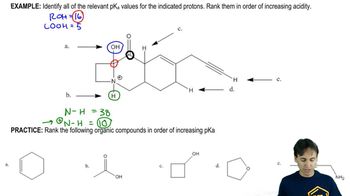
Identifying pKa values

Conjugate Base Stability

The stability of a conjugate base is crucial in determining the acidity of its corresponding acid. A more stable conjugate base results in a stronger acid. Stability can be influenced by factors such as resonance, inductive effects, and electronegativity. In ascorbic acid, the stability of the conjugate bases formed by deprotonation of different OH groups will help predict which OH group is the most acidic.
Recommended video:
Guided course
04:31
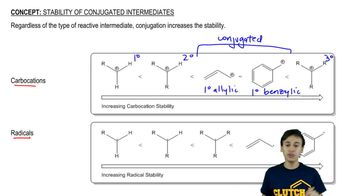
Stability of Conjugated Intermediates

Resonance and Electron Delocalization

Resonance involves the delocalization of electrons across adjacent atoms, which can stabilize a molecule or ion. In organic acids, resonance can stabilize the conjugate base by spreading the negative charge over multiple atoms. For ascorbic acid, analyzing the resonance structures of the conjugate bases formed by deprotonation of each OH group will help determine which base is most stable and, consequently, which OH group is most acidic.
Recommended video:
Guided course
03:32
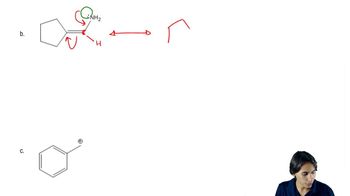
Drawing Resonance Structures