
Ch. 2 - Acids and Bases; Functional Groups
Wade - Organic Chemistry 9th Edition
Wade9th EditionOrganic ChemistryISBN: 9780135213728Not the one you use?Change textbook
Chapter 2, Problem 24g,h,i

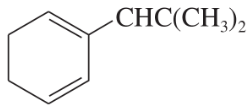
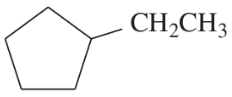
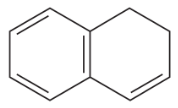
Classify the following hydrocarbons, and draw a Lewis structure for each one. A compound may fit into more than one of the following classifications:
alkane
alkene
alkyne
cycloalkane
cycloalkene
cycloalkyne
aromatic
hydrocarbon
(g)
(h)
(i)

Verified step by step guidance
1
Step 1: Begin by identifying the general formula for each type of hydrocarbon. Alkanes have the formula CnH2n+2, alkenes CnH2n, alkynes CnH2n-2, cycloalkanes CnH2n, cycloalkenes CnH2n-2, cycloalkynes CnH2n-4, and aromatic hydrocarbons typically follow the formula CnHn.
Step 2: Analyze the molecular formula of each compound (g, h, i) to determine which category or categories they fit into. Compare the number of carbon and hydrogen atoms to the general formulas identified in Step 1.
Step 3: Consider structural features such as rings or double/triple bonds. Cycloalkanes, cycloalkenes, and cycloalkynes contain rings, while alkenes and alkynes contain double and triple bonds respectively. Aromatic hydrocarbons have a distinct ring structure with alternating double bonds.
Step 4: Draw the Lewis structure for each compound. Start by arranging the carbon atoms in the appropriate structure (linear, cyclic, etc.), then add hydrogen atoms to satisfy the valency of carbon (four bonds per carbon atom). Ensure that double or triple bonds are correctly represented where applicable.
Step 5: Verify the classification by checking the drawn Lewis structure against the characteristics of each hydrocarbon type. Ensure that the structure adheres to the rules of organic chemistry, such as the octet rule for carbon and hydrogen.

Verified video answer for a similar problem:

This video solution was recommended by our tutors as helpful for the problem above.
Video duration:
4m
Was this helpful?

Key Concepts

Here are the essential concepts you must grasp in order to answer the question correctly.

Hydrocarbon Classification

Hydrocarbons are organic compounds consisting entirely of hydrogen and carbon. They are classified based on the types of bonds between carbon atoms: alkanes have single bonds, alkenes have at least one double bond, and alkynes have at least one triple bond. Cyclic hydrocarbons form rings, and aromatic hydrocarbons contain conjugated pi electron systems, typically in a ring structure like benzene.
Recommended video:
Guided course
04:52
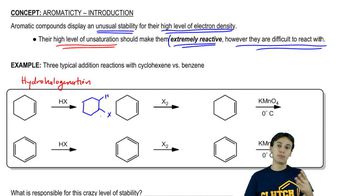
Aromaticity of Hydrocarbons

Lewis Structures

Lewis structures are diagrams that represent the bonding between atoms of a molecule and the lone pairs of electrons that may exist. They are essential for visualizing the arrangement of atoms and the distribution of electrons in a molecule, helping to predict molecular geometry, reactivity, and polarity. Each line represents a bond, and dots represent lone electrons.
Recommended video:
Guided course
04:12
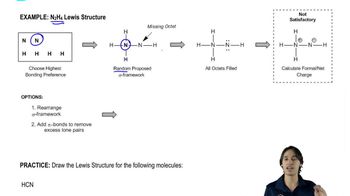
Drawing the Lewis Structure for N2H4.

Aromaticity

Aromatic hydrocarbons are a special class of cyclic compounds characterized by stability due to resonance. They follow Huckel's rule, which states that a molecule is aromatic if it has a planar ring structure with (4n+2) pi electrons, where n is a non-negative integer. This delocalization of electrons results in unique chemical properties, such as increased stability and distinctive reactivity patterns.
Recommended video:
Guided course
08:19
Intro to Aromaticity
Related Practice
Textbook Question

In the following acid–base reactions,

1. draw Lewis structures of the reactants and the products.

2. determine which species are acting as electrophiles (acids) and which are acting as nucleophiles (bases).

3. use the curved-arrow formalism to show the movement of electron pairs in these ­reactions, as well as the imaginary movement in the resonance hybrids of the products.

4. indicate which reactions are best termed Brønsted–Lowry acid–base reactions.

(b)

2
views
Textbook Question

Draw a Lewis structure, and classify each of the following compounds. The possible classifications are as follows:

alcohol

ether

ketone

aldehyde

carboxylic acid

alkene

(f)

(g)

1
views
Textbook Question

Draw a Lewis structure, and classify each of the following compounds. The possible classifications are as follows: alcohol ether ketone aldehyde carboxylic acid alkene

(d) CH3CH2OCHCH2

(e)

1
views
Textbook Question

Draw a Lewis structure, and classify each of the following compounds. The possible classifications are as follows:

alcohol

ether

ketone

aldehyde

carboxylic acid

alkene

(a) CH2CHCHO

(b) CH3CH2CH(OH)CH3

(c) CH3COCH2CH3

4
views
Textbook Question

Classify the following hydrocarbons, and draw a Lewis structure for each one. A compound may fit into more than one of the following classifications:

alkane

alkene

alkyne

cycloalkane

cycloalkene

cycloalkyne

aromatic

hydrocarbon

(d)

(e)

(f)

1
views
Textbook Question

Classify the following hydrocarbons, and draw a Lewis structure for each one. A compound may fit into more than one of the following classifications:

alkane

alkene

alkyne

cycloalkane

cycloalkene

cycloalkyne

aromatic

hydrocarbon

a. (CH3CH2)2CHCH(CH3)2

b. CH3CHCHCH2CH3

c.. CH3CCCH2CH2CH3

1
views