
Ch. 2 - Acids and Bases; Functional Groups
Wade - Organic Chemistry 9th Edition
Wade9th EditionOrganic ChemistryISBN: 9780135213728Not the one you use?Change textbook
Chapter 2, Problem 24a,b,c

Classify the following hydrocarbons, and draw a Lewis structure for each one. A compound may fit into more than one of the following classifications:
alkane
alkene
alkyne
cycloalkane
cycloalkene
cycloalkyne
aromatic
hydrocarbon
a. (CH3CH2)2CHCH(CH3)2
b. CH3CHCHCH2CH3
c.. CH3CCCH2CH2CH3

Verified step by step guidance
1
Identify the structure of each hydrocarbon by expanding the condensed formulas. For example, (CH3CH2)2CHCH(CH3)2 can be expanded to show all carbon and hydrogen atoms explicitly.
Classify each hydrocarbon based on the presence of single, double, or triple bonds, and any cyclic structures. For example, if a compound contains only single bonds, it is an alkane.
For compound a, (CH3CH2)2CHCH(CH3)2, recognize that it contains only single bonds and no rings, classifying it as an alkane.
For compound b, CH3CHCHCH2CH3, identify the presence of a double bond between the second and third carbon atoms, classifying it as an alkene.
For compound c, CH3CCCH2CH2CH3, note the presence of a triple bond between the second and third carbon atoms, classifying it as an alkyne.

Verified video answer for a similar problem:

This video solution was recommended by our tutors as helpful for the problem above.
Video duration:
4m
Was this helpful?

Key Concepts

Here are the essential concepts you must grasp in order to answer the question correctly.

Hydrocarbon Classification

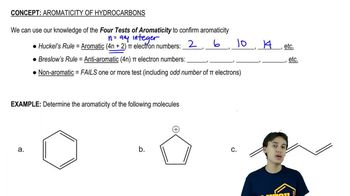
Hydrocarbons are classified based on the types of bonds between carbon atoms and their structural arrangement. Alkanes have single bonds, alkenes have at least one double bond, and alkynes have at least one triple bond. Cycloalkanes, cycloalkenes, and cycloalkynes are cyclic versions of these, while aromatic hydrocarbons contain conjugated pi electron systems, typically in ring structures like benzene.
Recommended video:
Guided course
04:52
Aromaticity of Hydrocarbons

Lewis Structures

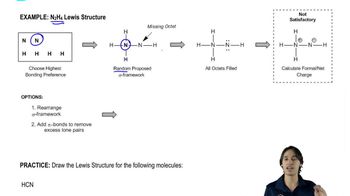
Lewis structures are diagrams that represent the bonding between atoms of a molecule and the lone pairs of electrons that may exist. They help visualize the arrangement of atoms, the types of bonds (single, double, triple), and the presence of lone pairs, which are crucial for understanding molecular geometry and reactivity.
Recommended video:
Guided course
04:12
Drawing the Lewis Structure for N2H4.

Structural Isomerism

Structural isomerism occurs when compounds have the same molecular formula but different structural arrangements of atoms. This concept is essential for identifying different types of hydrocarbons, as the arrangement of carbon atoms and the presence of functional groups like double or triple bonds can lead to different classifications and properties.
Recommended video:
Guided course
06:47
Monosaccharides - D and L Isomerism
Related Practice
Textbook Question

In the following acid–base reactions,

1. draw Lewis structures of the reactants and the products.

2. determine which species are acting as electrophiles (acids) and which are acting as nucleophiles (bases).

3. use the curved-arrow formalism to show the movement of electron pairs in these ­reactions, as well as the imaginary movement in the resonance hybrids of the products.

4. indicate which reactions are best termed Brønsted–Lowry acid–base reactions.

(a)

1
views
Textbook Question

Choose the more basic member of each pair of isomers, and show why the base you chose is more basic.

e.

2
views
Textbook Question

In the following acid–base reactions,

1. draw Lewis structures of the reactants and the products.

2. determine which species are acting as electrophiles (acids) and which are acting as nucleophiles (bases).

3. use the curved-arrow formalism to show the movement of electron pairs in these ­reactions, as well as the imaginary movement in the resonance hybrids of the products.

4. indicate which reactions are best termed Brønsted–Lowry acid–base reactions.

(b)

2
views
Textbook Question

Draw a Lewis structure, and classify each of the following compounds. The possible classifications are as follows:

alcohol

ether

ketone

aldehyde

carboxylic acid

alkene

(a) CH2CHCHO

(b) CH3CH2CH(OH)CH3

(c) CH3COCH2CH3

4
views
Textbook Question

Classify the following hydrocarbons, and draw a Lewis structure for each one. A compound may fit into more than one of the following classifications:

alkane

alkene

alkyne

cycloalkane

cycloalkene

cycloalkyne

aromatic

hydrocarbon

(g)

(h)

(i)

1
views
Textbook Question

Classify the following hydrocarbons, and draw a Lewis structure for each one. A compound may fit into more than one of the following classifications:

alkane

alkene

alkyne

cycloalkane

cycloalkene

cycloalkyne

aromatic

hydrocarbon

(d)

(e)

(f)

1
views