Ch.1 - Structure and Bonding
Wade - Organic Chemistry 9th Edition
Wade9th EditionOrganic ChemistryISBN: 9780135213728Not the one you use?Change textbook
Chapter 1, Problem 58d,e,f

Which of the following compounds show cis-trans isomerism? Draw the cis and trans isomers of the ones that do.
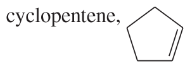
(d)
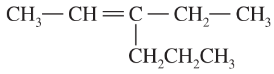
(e)
(f) CH3CH=NCH3

Verified step by step guidance
1
Step 1: Understand the concept of cis-trans isomerism. Cis-trans isomerism occurs in compounds with restricted rotation around a double bond or a ring structure, where two substituents can be positioned on the same side (cis) or opposite sides (trans).
Step 2: Analyze compound (d), cyclopentene. Cyclopentene has a double bond within a ring structure. Since the ring restricts rotation, cis-trans isomerism is possible. Draw the cis isomer with both substituents on the same side of the double bond and the trans isomer with substituents on opposite sides.
Step 3: Analyze compound (e), CH3CH=C(CH2CH2CH3)CH2CH3. This compound has a double bond between CH3CH and C(CH2CH2CH3). Check if the two groups attached to the double-bonded carbons are different. Since they are different, cis-trans isomerism is possible. Draw the cis isomer with the larger groups (CH2CH2CH3 and CH2CH3) on the same side and the trans isomer with them on opposite sides.
Step 4: Analyze compound (f), CH3CH=NCH3. This compound has a double bond between CH3CH and NCH3. However, nitrogen in the double bond does not allow for cis-trans isomerism because it does not have two distinct substituents attached to it. Therefore, cis-trans isomerism is not possible for this compound.
Step 5: Summarize the findings. Cis-trans isomerism is possible for compounds (d) cyclopentene and (e) CH3CH=C(CH2CH2CH3)CH2CH3. Draw the cis and trans isomers for these compounds as described in steps 2 and 3. Compound (f) does not exhibit cis-trans isomerism.

Verified video answer for a similar problem:

This video solution was recommended by our tutors as helpful for the problem above.
Video duration:
4m
Was this helpful?

Key Concepts

Here are the essential concepts you must grasp in order to answer the question correctly.

Cis-Trans Isomerism

Cis-trans isomerism, also known as geometric isomerism, occurs in compounds with restricted rotation around a double bond or a ring structure. In cis isomers, substituents are on the same side of the double bond or ring, while in trans isomers, they are on opposite sides. This difference in spatial arrangement can lead to distinct physical and chemical properties.
Recommended video:
Guided course
00:44
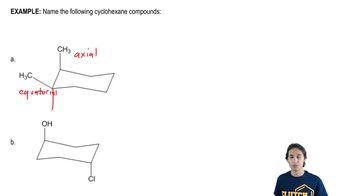
Is the following cyclohexane cis or trans?

Alkenes and Ring Structures

Alkenes are hydrocarbons that contain at least one carbon-carbon double bond, which is crucial for the existence of cis-trans isomers. Additionally, cyclic compounds, like cyclopentene, can also exhibit this type of isomerism due to the rigidity of their structure, which restricts the rotation around the double bond, allowing for different spatial arrangements of substituents.
Recommended video:
1:59
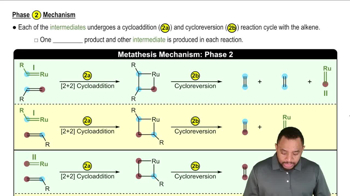
Alkene Metathesis Concept 5

Drawing Isomers

To illustrate cis and trans isomers, one must accurately represent the molecular structure, showing the relative positions of substituents around the double bond or ring. This involves using structural formulas to depict the connectivity of atoms and ensuring that the orientation of groups reflects whether they are on the same side (cis) or opposite sides (trans) of the double bond or ring.
Recommended video:
Guided course
01:10
What is a constitutional isomer?