Ch.1 - Structure and Bonding
Wade - Organic Chemistry 9th Edition
Wade9th EditionOrganic ChemistryISBN: 9780135213728Not the one you use?Change textbook
Chapter 1, Problem 60

Dimethyl sulfoxide (DMSO) has been used as an anti-inflammatory rub for race horses. DMSO and acetone appear to have similar structures, but the C=O carbon atom in acetone is planar, while the S=O sulfur atom in DMSO is ­pyramidal. Draw Lewis structures for DMSO and acetone, predict the hybridizations, and explain these observations.
Lewis structures of dimethyl sulfoxide (DMSO) and acetone for comparison.

Verified step by step guidance
1
Begin by drawing the Lewis structure for acetone. Acetone has the formula \( \text{C}_3\text{H}_6\text{O} \). The central carbon atom is bonded to two methyl groups (\( \text{CH}_3 \)) and an oxygen atom through a double bond. The carbon atom in the \( \text{C}=\text{O} \) bond is sp² hybridized, which results in a planar geometry.
Next, draw the Lewis structure for dimethyl sulfoxide (DMSO). DMSO has the formula \( \text{C}_2\text{H}_6\text{OS} \). The sulfur atom is bonded to two methyl groups (\( \text{CH}_3 \)) and an oxygen atom through a double bond. The sulfur atom in the \( \text{S}=\text{O} \) bond is sp³ hybridized, which results in a pyramidal geometry.
To predict the hybridization of the central atoms, consider the number of electron domains around each atom. In acetone, the carbon atom has three electron domains (two single bonds and one double bond), leading to sp² hybridization. In DMSO, the sulfur atom has four electron domains (two single bonds, one double bond, and one lone pair), leading to sp³ hybridization.
Explain the difference in geometry: The sp² hybridization in acetone results in a trigonal planar geometry around the carbon atom, making the \( \text{C}=\text{O} \) bond planar. In contrast, the sp³ hybridization in DMSO results in a tetrahedral arrangement, but the presence of a lone pair on sulfur leads to a pyramidal shape for the \( \text{S}=\text{O} \) bond.
Summarize the observations: The planar geometry of acetone is due to the sp² hybridization of the carbon atom, while the pyramidal geometry of DMSO is due to the sp³ hybridization of the sulfur atom, influenced by the lone pair of electrons.

Verified video answer for a similar problem:

This video solution was recommended by our tutors as helpful for the problem above.
Video duration:
5m
Was this helpful?

Key Concepts

Here are the essential concepts you must grasp in order to answer the question correctly.

Lewis Structures

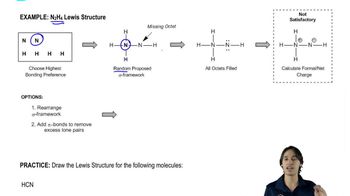
Lewis structures are diagrams that represent the bonding between atoms in a molecule and the lone pairs of electrons that may exist. They help visualize the arrangement of electrons and the connectivity of atoms, which is crucial for understanding molecular geometry and reactivity. In the case of DMSO and acetone, drawing their Lewis structures reveals the differences in bonding and electron distribution around the central atoms.
Recommended video:
Guided course
04:12
Drawing the Lewis Structure for N2H4.

Hybridization

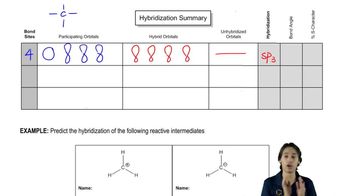
Hybridization is the concept of mixing atomic orbitals to form new hybrid orbitals that can accommodate the bonding requirements of a molecule. In DMSO, the sulfur atom undergoes sp³ hybridization due to its pyramidal geometry, while the carbon atom in acetone is sp² hybridized, resulting in a planar structure. Understanding hybridization is essential for predicting molecular shapes and bond angles.
Recommended video:
Guided course
10:43
Using bond sites to predict hybridization

Molecular Geometry

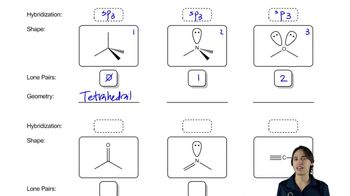
Molecular geometry refers to the three-dimensional arrangement of atoms within a molecule, which is influenced by the types of bonds and lone pairs present. The pyramidal shape of DMSO arises from the presence of a lone pair on sulfur, while the planar structure of acetone is due to the absence of lone pairs on the carbon atom. Recognizing these geometrical differences is key to understanding the physical and chemical properties of these compounds.
Recommended video:
Guided course
07:44
Molecular Geometry Explained.