Ch. 9 - Alkenes II: Oxidation and Reduction
Mullins - Organic Chemistry: A Learner Centered Approach 1st Edition
Mullins1st EditionOrganic Chemistry: A Learner Centered ApproachISBN: 9780137566471Not the one you use?Change textbook
Chapter 8, Problem 24

There are two mechanisms by which each of the two enantiomers can form in the reaction shown in Figure 9.37. Show them.
<IMAGE>

Verified step by step guidance
1
Step 1: The reaction begins with the formation of an epoxide from the alkene. This occurs via the reaction of the alkene with a peracid (persulfonic acid in this case), which transfers an oxygen atom to the double bond, forming a three-membered epoxide ring. This step is stereospecific and retains the stereochemistry of the starting alkene.
Step 2: The epoxide undergoes an acid-base reaction in the presence of the sulfonic acid catalyst. The oxygen in the epoxide ring is protonated, making the ring more electrophilic and susceptible to nucleophilic attack.
Step 3: The protonated epoxide is opened by water, which acts as a nucleophile. The attack can occur at either carbon of the epoxide ring, leading to the formation of two different enantiomers. The stereochemistry of the product depends on the direction of the nucleophilic attack.
Step 4: The resulting intermediate undergoes a second acid-base reaction, where a proton is transferred to regenerate the sulfonic acid catalyst. This step ensures the catalytic cycle continues.
Step 5: The final products are two enantiomers of the diol, formed as a result of the stereospecific opening of the epoxide ring. The persulfonic acid is regenerated in the process, completing the catalytic cycle.

Verified video answer for a similar problem:

This video solution was recommended by our tutors as helpful for the problem above.
Was this helpful?

Key Concepts

Here are the essential concepts you must grasp in order to answer the question correctly.

Enantiomers

Enantiomers are a type of stereoisomer that are non-superimposable mirror images of each other. They have the same molecular formula and connectivity but differ in the spatial arrangement of atoms. This property is crucial in organic chemistry, especially in reactions involving chiral centers, as enantiomers can exhibit different biological activities and reactivities.
Recommended video:
Guided course
03:23
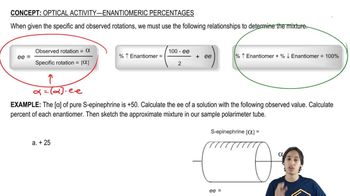
How to solve for the percentage of each enantiomer.

Chirality

Chirality refers to the geometric property of a molecule that makes it non-superimposable on its mirror image. A chiral molecule typically has at least one carbon atom bonded to four different substituents, creating two distinct configurations. Understanding chirality is essential for predicting the formation of enantiomers in chemical reactions, as it influences how molecules interact with other chiral environments.
Recommended video:
Guided course
05:10
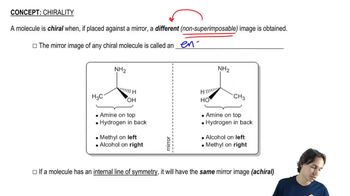
What is chirality?

Reaction Mechanisms

A reaction mechanism is a step-by-step description of the process by which reactants are converted into products. It outlines the sequence of bond-breaking and bond-forming events, including the formation of intermediates and transition states. In the context of enantiomer formation, understanding the mechanism helps in identifying how each enantiomer is produced and the role of stereochemistry in the reaction.
Recommended video:
Guided course
02:16
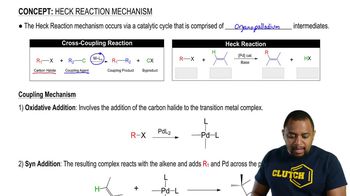
Heck Reaction Mechanism