Ch. 9 - Alkenes II: Oxidation and Reduction
Mullins - Organic Chemistry: A Learner Centered Approach 1st Edition
Mullins1st EditionOrganic Chemistry: A Learner Centered ApproachISBN: 9780137566471Not the one you use?Change textbook
Chapter 8, Problem 46

Rank the reactivity of the following alkenes with mCPBA ( 1 = most reactive , 5 least reactive ).
Structures of five alkenes for ranking their reactivity with mCPBA in epoxidation reactions.

Verified step by step guidance
1
Identify the structure of each alkene provided in the problem. Look for features such as electron-donating or electron-withdrawing groups attached to the double bond, as these influence reactivity with mCPBA (meta-chloroperoxybenzoic acid).
Recall that mCPBA is an electrophilic oxidizing agent used to convert alkenes into epoxides. Alkenes with electron-donating groups (e.g., alkyl groups) are more reactive because they increase the electron density on the double bond, making it more nucleophilic.
Rank the alkenes based on the presence and strength of electron-donating or electron-withdrawing groups. For example, alkenes with alkyl substituents will generally be more reactive than those with electron-withdrawing groups (e.g., halogens, nitro groups).
Consider steric hindrance around the double bond. Alkenes with less steric hindrance are more accessible to the mCPBA molecule and will react more readily.
Combine the effects of electronic and steric factors to assign a reactivity ranking (1 = most reactive, 5 = least reactive). Ensure that you carefully evaluate each alkene based on these principles.

Verified video answer for a similar problem:

This video solution was recommended by our tutors as helpful for the problem above.
Video duration:
5m
Was this helpful?

Key Concepts

Here are the essential concepts you must grasp in order to answer the question correctly.

Alkenes and Their Reactivity

Alkenes are hydrocarbons that contain at least one carbon-carbon double bond (C=C). Their reactivity is influenced by the stability of the double bond and the substituents attached to the carbon atoms. Generally, more substituted alkenes are more stable and less reactive, while less substituted alkenes are more reactive due to their higher strain and lower stability.
Recommended video:
2:09
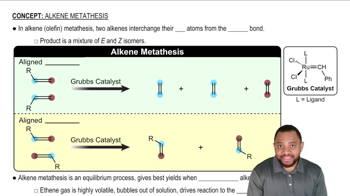
Alkene Metathesis Concept 1

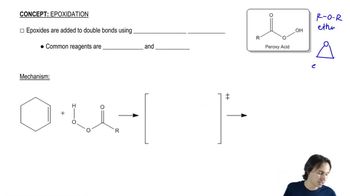
mCPBA and Epoxidation

mCPBA (meta-Chloroperbenzoic acid) is a peracid commonly used in organic chemistry for the epoxidation of alkenes. This reaction involves the formation of a three-membered cyclic ether called an epoxide, which is a highly reactive intermediate. The reactivity of alkenes with mCPBA depends on their substitution pattern, with less hindered alkenes typically reacting more readily.
Recommended video:
Guided course
02:19
General properties of epoxidation.

Steric Hindrance

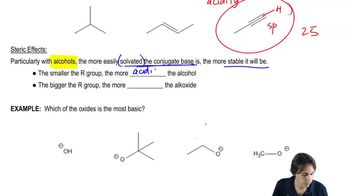
Steric hindrance refers to the prevention of reactions at a particular location in a molecule due to the size of substituent groups. In the context of alkenes, bulky groups around the double bond can impede the approach of mCPBA, reducing the rate of epoxidation. Understanding steric effects is crucial for predicting the reactivity of different alkenes in reactions with mCPBA.
Recommended video:
Guided course
02:53
Understanding steric effects.