Ch. 9 - Alkenes II: Oxidation and Reduction
Mullins - Organic Chemistry: A Learner Centered Approach 1st Edition
Mullins1st EditionOrganic Chemistry: A Learner Centered ApproachISBN: 9780137566471Not the one you use?Change textbook
Chapter 8, Problem 45l(vii,viii)

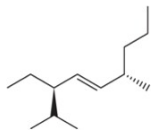
Predict the product(s) that would result when the alkenes are allowed to react under the following conditions: (vii) 1. mCPBA 2. H2SO4, H2O (viii) 1. O3 2. CH3SCH3
(l)

Verified step by step guidance
1
Step 1: Analyze the structure of the given alkene. The molecule contains a double bond, which is the reactive site for the reactions described in the problem.
Step 2: For reaction (vii), mCPBA (meta-chloroperoxybenzoic acid) is a reagent used for epoxidation. This reaction will convert the double bond into an epoxide by adding an oxygen atom across the double bond. The stereochemistry of the epoxide will depend on the approach of the mCPBA.
Step 3: For reaction (viii), the sequence involves ozonolysis followed by reduction with dimethyl sulfide (CH₃SCH₃). Ozonolysis cleaves the double bond, forming two carbonyl compounds (aldehydes or ketones) depending on the substituents attached to the double bond.
Step 4: Apply the ozonolysis mechanism to the given alkene. Break the double bond and add oxygen atoms to each carbon of the double bond to form two carbonyl groups. Use the structure of the alkene to determine the specific aldehydes or ketones formed.
Step 5: Combine the results of both reactions. For (vii), the product is an epoxide. For (viii), the products are carbonyl compounds resulting from the cleavage of the double bond. Ensure the stereochemistry and connectivity of the products are consistent with the starting material.

Verified video answer for a similar problem:

This video solution was recommended by our tutors as helpful for the problem above.
Was this helpful?

Key Concepts

Here are the essential concepts you must grasp in order to answer the question correctly.

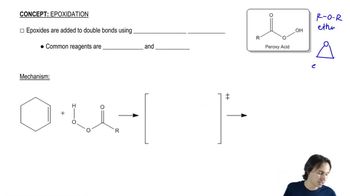
Epoxidation

Epoxidation is a reaction where an alkene is converted into an epoxide, a three-membered cyclic ether. This transformation typically occurs using peracids, such as mCPBA (meta-chloroperbenzoic acid), which adds an oxygen atom across the double bond of the alkene. Understanding this reaction is crucial for predicting the products when alkenes react with mCPBA.
Recommended video:
Guided course
02:19
General properties of epoxidation.

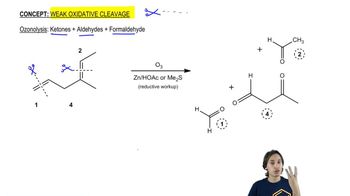
Ozonolysis

Ozonolysis is a reaction involving the cleavage of alkenes using ozone (O₃), resulting in the formation of carbonyl compounds, such as aldehydes or ketones. The reaction proceeds through the formation of an ozonide intermediate, which is then reduced, often using a reagent like dimethyl sulfide (CH₃SCH₃). This concept is essential for predicting the products when alkenes are treated with ozone followed by a reductive workup.
Recommended video:
Guided course
06:30
General properties of ozonolysis.

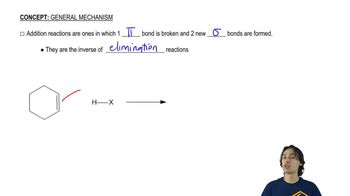
Mechanism of Electrophilic Addition

The mechanism of electrophilic addition describes how alkenes react with electrophiles, leading to the formation of more stable products. In the case of epoxidation and ozonolysis, understanding the stepwise addition of reagents to the double bond is key to predicting the final products. This concept encompasses the reactivity of alkenes and the nature of the intermediates formed during these reactions.
Recommended video:
Guided course
05:39
Features of Addition Mechanisms.