
Ch. 8 - Alkenes I: Properties and Electrophilic Additions
Mullins - Organic Chemistry: A Learner Centered Approach 1st Edition
Mullins1st EditionOrganic Chemistry: A Learner Centered ApproachISBN: 9780137566471Not the one you use?Change textbook
Chapter 7, Problem 37c

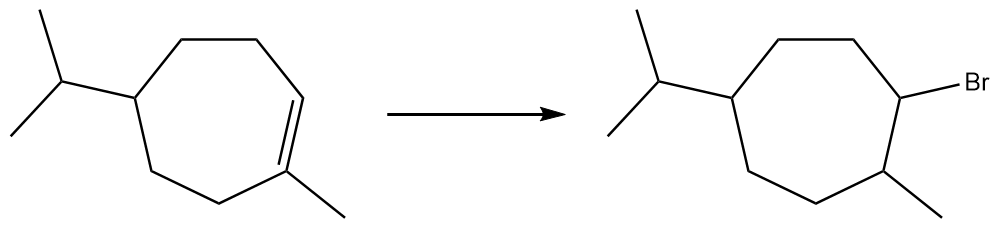
Which reagent system (HBr or HBr, H2O2) would you use to carry out the following transformations?
(c) Chemical reaction showing anti Markovnikov addition of Br to a cyclohexene derivative.

Verified step by step guidance
1
Identify the type of reaction: The transformation involves the addition of bromine (Br) to an alkene, which is a typical electrophilic addition reaction.
Consider the regioselectivity: The product shows bromine added to the less substituted carbon of the double bond, indicating anti-Markovnikov addition.
Select the reagent system: Anti-Markovnikov addition of HBr to alkenes is achieved using HBr in the presence of peroxides (H₂O₂).
Understand the mechanism: The presence of peroxides leads to the formation of free radicals, which initiate the anti-Markovnikov addition by adding Br to the less substituted carbon.
Conclude the reagent choice: For the given transformation, use HBr with H₂O₂ to achieve the desired anti-Markovnikov addition of bromine.

Verified video answer for a similar problem:

This video solution was recommended by our tutors as helpful for the problem above.
Video duration:
3m
Was this helpful?

Key Concepts

Here are the essential concepts you must grasp in order to answer the question correctly.

Markovnikov's Rule

Markovnikov's Rule states that in the addition of HX to an alkene, the hydrogen atom will attach to the carbon with the greater number of hydrogen atoms already attached, while the halide (X) will attach to the carbon with fewer hydrogen atoms. This rule helps predict the major product of electrophilic addition reactions.
Recommended video:
Guided course
03:54
The 18 and 16 Electron Rule

Anti-Markovnikov Addition

Anti-Markovnikov addition occurs when the addition of HX to an alkene results in the halide attaching to the less substituted carbon atom. This is typically facilitated by the presence of peroxides (like H2O2) in the reaction, which alters the mechanism and leads to the formation of the less stable radical intermediate.
Recommended video:
Guided course
02:43
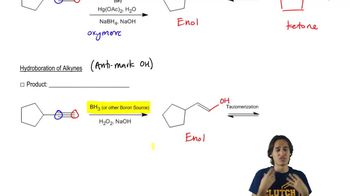
Anti-Markovnikov addition of alcohols to terminal alkynes yields aldehydes

Reagent Selection in Organic Reactions

Choosing the appropriate reagent system is crucial in organic chemistry as it influences the reaction pathway and the final product. In this case, HBr alone would lead to Markovnikov addition, while HBr in the presence of H2O2 promotes anti-Markovnikov addition, making it essential to select the right system based on the desired outcome.
Recommended video:
Guided course
02:17
Identifying organic molecules