Textbook Question
Provide the expected product for the reaction of each of the following alkenes with (i) HBr and (ii) HBr, H2O2.
(e)
2
views

 Mullins 1st EditionCh. 8 - Alkenes I: Properties and Electrophilic AdditionsProblem 37a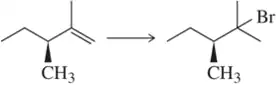
 Verified step by step guidance
 03:54
03:54
 02:43
02:43 03:28
03:28Provide the expected product for the reaction of each of the following alkenes with (i) HBr and (ii) HBr, H2O2.
(e)
Radical addition to alkenes is not effective for the synthesis of iodo- and chloroalkanes. Using your knowledge of the mechanism of this reaction, along with bond dissociation energies, explain why the radical additions of HI and HCl are not effective. (Assume ∆H = 65 kcal/ mol for the C–C π bond.)
Which reagent system (HBr or HBr, H2O2) would you use to carry out the following transformations?
(c)
Provide an arrow-pushing mechanism that rationalizes the formation of each of the products you predicted in Assessment 8.35 (ii). Make sure your mechanism accounts for all products formed, including stereoisomers and regioisomers, where applicable.
Provide the expected product for the reaction of each of the following alkenes with (i) HBr and (ii) HBr, H2O2.
(d)
Which reagent system (HBr or HBr, H2O2) would you use to carry out the following transformations?
(b)