Ch. 8 - Alkenes I: Properties and Electrophilic Additions
Mullins - Organic Chemistry: A Learner Centered Approach 1st Edition
Mullins1st EditionOrganic Chemistry: A Learner Centered ApproachISBN: 9780137566471Not the one you use?Change textbook
Chapter 7, Problem 52

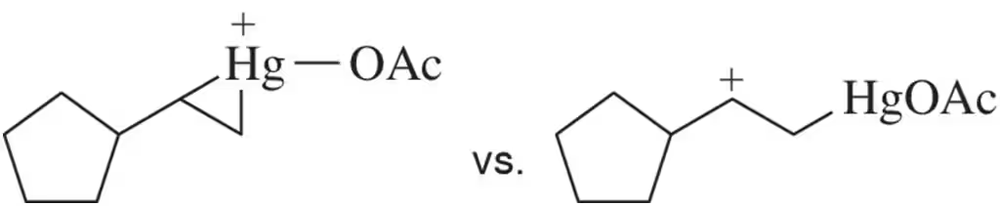
Which is more stable, a carbocation or a mercurinium ion? How do you know?
Comparison of carbocation and mercurinium ion structures, highlighting stability differences.

Verified step by step guidance
1
Understand the nature of the two species: A carbocation is a positively charged carbon atom with three bonds and an empty p orbital. A mercurinium ion is a cyclic structure where mercury is bonded to two carbon atoms, creating a three-membered ring with a positive charge on the mercury.
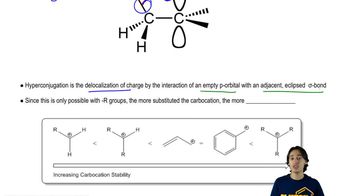
Consider the stability factors: Carbocations are stabilized by hyperconjugation and resonance. The more alkyl groups attached to the carbocation, the more stable it is due to hyperconjugation. Resonance can also stabilize carbocations if there are adjacent π systems.
Analyze the mercurinium ion: The mercurinium ion is stabilized by the back-donation of electron density from the mercury atom to the carbon atoms. This creates a partial positive charge on the mercury, reducing the overall positive charge of the ion.
Compare the electronic effects: Carbocations are generally less stable due to the full positive charge on the carbon atom, which lacks the ability to delocalize the charge effectively compared to the mercurinium ion.
Conclude based on stability: The mercurinium ion is typically more stable than a carbocation due to the ability of mercury to delocalize the positive charge across the ring, reducing the energy of the system.

Verified video answer for a similar problem:

This video solution was recommended by our tutors as helpful for the problem above.
Video duration:
4m
Was this helpful?

Key Concepts

Here are the essential concepts you must grasp in order to answer the question correctly.

Carbocation Stability

Carbocations are positively charged carbon atoms with three bonds and a vacant p-orbital. Their stability is influenced by the degree of alkyl substitution, resonance, and hyperconjugation. Tertiary carbocations are more stable than secondary and primary ones due to greater electron-donating effects from surrounding alkyl groups.
Recommended video:
Guided course
05:58
Determining Carbocation Stability

Mercurinium Ion Structure

Mercurinium ions are intermediates formed during oxymercuration reactions, where mercury is bonded to two carbons, creating a three-membered ring. This structure stabilizes the positive charge through back-donation from mercury's filled orbitals, making mercurinium ions generally more stable than carbocations due to reduced charge localization.
Recommended video:
3:39
Metal Ion Catalysis Concept 1

Comparative Stability Analysis

To compare the stability of carbocations and mercurinium ions, consider factors like charge distribution and resonance. Mercurinium ions benefit from a more delocalized charge due to the involvement of mercury, which can stabilize the positive charge better than the localized charge in carbocations, making mercurinium ions typically more stable.
Recommended video:
Guided course
03:43
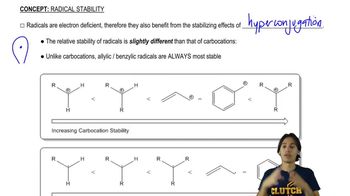
The radical stability trend.