Ch. 8 - Alkenes I: Properties and Electrophilic Additions
Mullins - Organic Chemistry: A Learner Centered Approach 1st Edition
Mullins1st EditionOrganic Chemistry: A Learner Centered ApproachISBN: 9780137566471Not the one you use?Change textbook
Chapter 7, Problem 54a

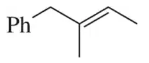
Predict the products you would get when the following alkenes undergo (i) hydroboration–oxidation (1. BH3 2. NaOH, H2O2 or (ii) oxymercuration–reduction [1. Hg(OAc)2, H2O 2. NaBH4].
(a)

Verified step by step guidance
1
Step 1: Analyze the given alkene structure. The molecule contains a phenyl group (Ph) attached to a carbon chain with a double bond located between the second and third carbons in the chain.
Step 2: For hydroboration–oxidation (1. BH3, 2. NaOH, H2O2), the reaction proceeds via anti-Markovnikov addition of water across the double bond. The boron atom initially adds to the less substituted carbon of the double bond, followed by oxidation to replace the boron with a hydroxyl group (-OH). This results in the alcohol being formed at the less substituted carbon.
Step 3: For oxymercuration–reduction (1. Hg(OAc)2, H2O, 2. NaBH4), the reaction proceeds via Markovnikov addition of water across the double bond. The mercury intermediate forms at the more substituted carbon, and during reduction, the mercury is replaced with a hydroxyl group (-OH). This results in the alcohol being formed at the more substituted carbon.
Step 4: Consider stereochemistry. Hydroboration–oxidation typically results in syn addition (both the hydrogen and hydroxyl group add to the same face of the double bond), while oxymercuration–reduction does not involve stereospecificity.
Step 5: Predict the products. For hydroboration–oxidation, the alcohol will form at the less substituted carbon of the double bond. For oxymercuration–reduction, the alcohol will form at the more substituted carbon of the double bond. Ensure the phenyl group remains unaffected in both reactions.

Verified video answer for a similar problem:

This video solution was recommended by our tutors as helpful for the problem above.
Video duration:
7m
Was this helpful?

Key Concepts

Here are the essential concepts you must grasp in order to answer the question correctly.

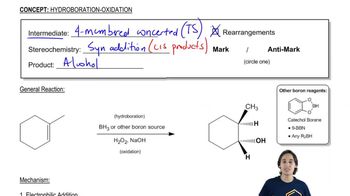
Hydroboration-Oxidation

Hydroboration-oxidation is a two-step reaction that converts alkenes into alcohols. In the first step, BH₃ adds to the alkene, forming a trialkylborane intermediate. This is followed by oxidation with hydrogen peroxide (H₂O₂) and a base (NaOH), which converts the boron to an alcohol. This reaction is stereospecific and results in anti-Markovnikov addition, meaning the hydroxyl group attaches to the less substituted carbon.
Recommended video:
Guided course
06:38
General properties of hydroboration-oxidation.

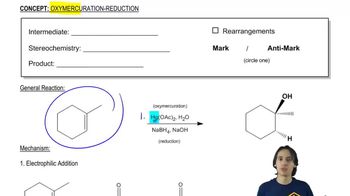
Oxymercuration-Reduction

Oxymercuration-reduction is another method for converting alkenes to alcohols, involving two steps. Initially, the alkene reacts with mercuric acetate (Hg(OAc)₂) in the presence of water, leading to the formation of a mercurial intermediate. The subsequent reduction with sodium borohydride (NaBH₄) replaces the mercury with a hydrogen atom, yielding an alcohol. This reaction follows Markovnikov's rule, where the hydroxyl group attaches to the more substituted carbon.
Recommended video:
Guided course
05:
General properties of oxymercuration-reduction.

Markovnikov's Rule

Markovnikov's rule is a principle in organic chemistry that predicts the outcome of electrophilic addition reactions to alkenes. It states that when HX (where X is a halogen or hydroxyl group) adds to an asymmetric alkene, the more stable carbocation will form, leading to the more substituted carbon receiving the electrophile. This rule is crucial for understanding the regioselectivity of reactions like oxymercuration-reduction, where the product distribution is influenced by the stability of the intermediates formed.
Recommended video:
Guided course
03:54
The 18 and 16 Electron Rule