Ch. 8 - Alkenes I: Properties and Electrophilic Additions
Mullins - Organic Chemistry: A Learner Centered Approach 1st Edition
Mullins1st EditionOrganic Chemistry: A Learner Centered ApproachISBN: 9780137566471Not the one you use?Change textbook
Chapter 7, Problem 17

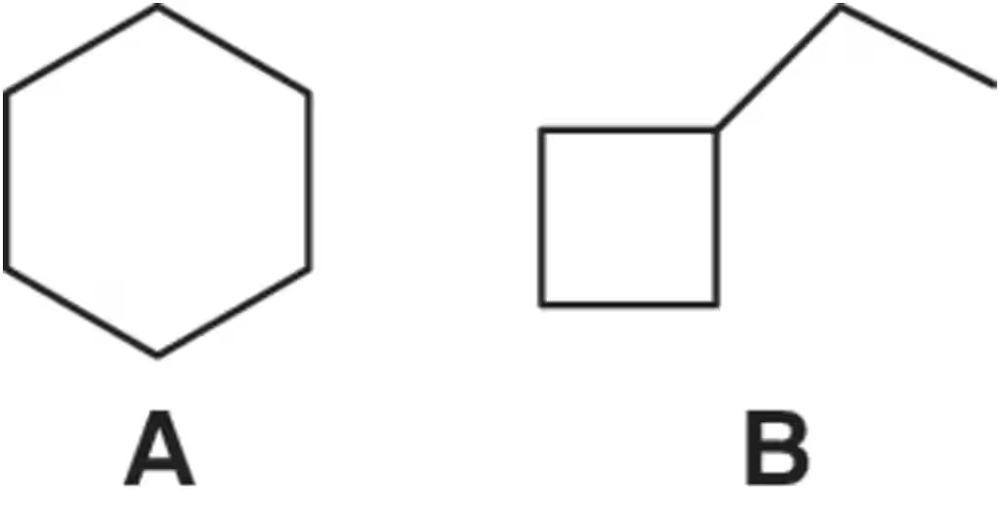
Which constitutional isomer, A or B, would you expect to have the highest heat of combustion (∆Hcombustion)?
Structural formulas of two constitutional isomers labeled A and B, asking which has the highest heat of combustion.

Verified step by step guidance
1
Understand the concept: The heat of combustion (∆H꜀ₒₘ₆ᵤₛₜᵢₒₙ) is the energy released when one mole of a compound is completely burned in oxygen. For constitutional isomers, the compound with less stability will have a higher heat of combustion because it starts at a higher energy level.
Analyze the structures of isomers A and B: Constitutional isomers have the same molecular formula but differ in the connectivity of their atoms. Look for factors such as branching, which can influence stability. More branching generally increases stability, while less branching decreases it.
Compare branching in A and B: Determine which isomer is more branched. A more branched isomer will be more stable due to reduced steric strain and better distribution of electron density, leading to a lower heat of combustion.
Relate stability to heat of combustion: The less stable isomer (less branched) will have a higher heat of combustion because it has more potential energy to release during combustion.
Conclude which isomer has the higher heat of combustion: Based on the branching analysis, identify whether A or B is less stable and thus has the higher ∆H꜀ₒₘ₆ᵤₛₜᵢₒₙ.

Verified video answer for a similar problem:

This video solution was recommended by our tutors as helpful for the problem above.
Video duration:
2m
Was this helpful?

Key Concepts

Here are the essential concepts you must grasp in order to answer the question correctly.

Constitutional Isomers

Constitutional isomers are compounds that have the same molecular formula but differ in the connectivity of their atoms. This means that the arrangement of atoms in space is different, leading to distinct chemical and physical properties. Understanding the structural differences between isomers is crucial for predicting their reactivity and stability.
Recommended video:
Guided course
01:10
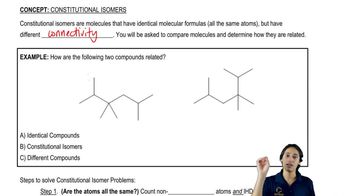
What is a constitutional isomer?

Heat of Combustion (∆H꜀ₒₘ₆ᵤₛₜᵢₒₙ)

The heat of combustion is the amount of energy released when a substance is completely burned in oxygen. It is typically expressed in kilojoules per mole (kJ/mol). The heat of combustion can provide insights into the stability of a compound; generally, more stable compounds release less energy upon combustion compared to less stable ones.
Recommended video:
Guided course
02:55
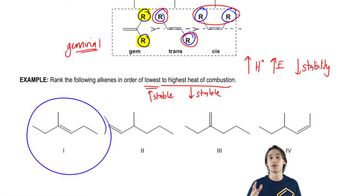
Heat of Combustion

Stability and Energy Considerations

In organic chemistry, the stability of a molecule is often related to its energy content. More stable isomers tend to have lower energy and, consequently, a lower heat of combustion. Factors influencing stability include steric hindrance, degree of branching, and the presence of functional groups. Analyzing these factors helps predict which isomer will have a higher heat of combustion.
Recommended video:
Guided course
03:43
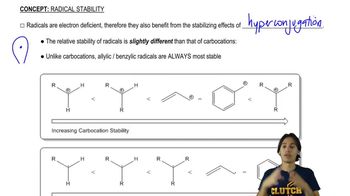
The radical stability trend.