Ch. 8 - Alkenes I: Properties and Electrophilic Additions
Mullins - Organic Chemistry: A Learner Centered Approach 1st Edition
Mullins1st EditionOrganic Chemistry: A Learner Centered ApproachISBN: 9780137566471Not the one you use?Change textbook
Chapter 7, Problem 16

How many stereoisomers are possible (a) for 4-methylnona-2,7-diene? (b) For 6-chloronona-2,4,7-triene?

Verified step by step guidance
1
Step 1: Understand the concept of stereoisomers. Stereoisomers are compounds with the same molecular formula and connectivity of atoms but differ in the spatial arrangement of atoms. For alkenes, stereoisomerism arises due to restricted rotation around the double bond, leading to cis-trans (E/Z) isomerism. Additionally, chiral centers can also contribute to stereoisomerism.
Step 2: Analyze the structure of 4-methylnona-2,7-diene. This compound contains two double bonds (at positions 2 and 7) and a methyl group at position 4. Each double bond can exhibit cis-trans (E/Z) isomerism. Check if there are any chiral centers in the molecule, as they can further increase the number of stereoisomers.
Step 3: Calculate the number of stereoisomers for 4-methylnona-2,7-diene. For each double bond, there are two possible configurations (E or Z). Multiply the possibilities for each double bond. If there are no chiral centers, the total number of stereoisomers is simply 2^n, where n is the number of double bonds capable of E/Z isomerism.
Step 4: Analyze the structure of 6-chloronona-2,4,7-triene. This compound contains three double bonds (at positions 2, 4, and 7) and a chlorine atom at position 6. Each double bond can exhibit cis-trans (E/Z) isomerism. Check if the chlorine atom creates a chiral center (a carbon atom bonded to four different groups). If so, this will add to the total number of stereoisomers.
Step 5: Calculate the number of stereoisomers for 6-chloronona-2,4,7-triene. For the three double bonds, there are 2^3 = 8 possible configurations (E/Z). If the chlorine atom creates a chiral center, multiply the number of configurations by 2 to account for the additional stereoisomerism. Combine these factors to determine the total number of stereoisomers.

Verified video answer for a similar problem:

This video solution was recommended by our tutors as helpful for the problem above.
Video duration:
2m
Was this helpful?

Key Concepts

Here are the essential concepts you must grasp in order to answer the question correctly.

Stereoisomerism

Stereoisomerism refers to the phenomenon where compounds have the same molecular formula and connectivity of atoms but differ in the spatial arrangement of their atoms. This can lead to different physical and chemical properties. The two main types of stereoisomers are enantiomers, which are non-superimposable mirror images, and diastereomers, which are not mirror images of each other.
Recommended video:
Guided course
01:58
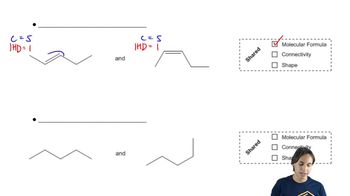
Determining when molecules are stereoisomers.

Cis-Trans Isomerism

Cis-trans isomerism is a specific type of stereoisomerism that occurs in alkenes and cyclic compounds, where the relative positioning of substituents around a double bond or ring structure can differ. In cis isomers, similar groups are on the same side, while in trans isomers, they are on opposite sides. This distinction can significantly affect the physical properties and reactivity of the compounds.
Recommended video:
Guided course
00:44
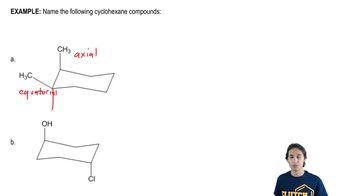
Is the following cyclohexane cis or trans?

Counting Stereoisomers

The number of possible stereoisomers for a compound can be determined using the formula 2^n, where n is the number of stereocenters in the molecule. Additionally, for compounds with double bonds, the presence of cis-trans isomerism must also be considered. This requires careful analysis of the structure to identify all stereocenters and geometric isomers, leading to a comprehensive count of stereoisomers.
Recommended video:
Guided course
07:07
Electron Counting