Ch. 8 - Alkenes I: Properties and Electrophilic Additions
Mullins - Organic Chemistry: A Learner Centered Approach 1st Edition
Mullins1st EditionOrganic Chemistry: A Learner Centered ApproachISBN: 9780137566471Not the one you use?Change textbook
Chapter 7, Problem 61g(iv)

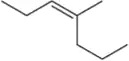
Predict the product(s) that would result when the alkenes shown here are allowed to react under the following conditions: (iv) H2SO4 , H2O
(g) Structural representation of alkenes for hydrohalogenation reaction with HBr.

Verified step by step guidance
1
Step 1: Identify the type of reaction. The given reagents, H₂SO₄ (sulfuric acid) and H₂O (water), indicate that the reaction is an acid-catalyzed hydration of an alkene. This reaction adds water (H and OH) across the double bond of the alkene.
Step 2: Determine the regioselectivity of the reaction. Acid-catalyzed hydration follows Markovnikov's rule, meaning the hydrogen (H) will add to the carbon of the double bond that already has more hydrogens, and the hydroxyl group (OH) will add to the carbon with fewer hydrogens.
Step 3: Consider the mechanism. The reaction proceeds via the formation of a carbocation intermediate. The alkene's π electrons attack the proton (H⁺) from H₂SO₄, forming a carbocation at the more stable position (tertiary > secondary > primary).
Step 4: Add the hydroxyl group. Once the carbocation is formed, water (H₂O) acts as a nucleophile and attacks the carbocation, forming an oxonium ion. This intermediate is then deprotonated to yield the final alcohol product.
Step 5: Predict the product structure. Based on the alkene's structure and the application of Markovnikov's rule, draw the product where the OH group is attached to the more substituted carbon of the original double bond, and the H is attached to the less substituted carbon.

Verified video answer for a similar problem:

This video solution was recommended by our tutors as helpful for the problem above.
Video duration:
3m
Was this helpful?

Key Concepts

Here are the essential concepts you must grasp in order to answer the question correctly.

Electrophilic Addition

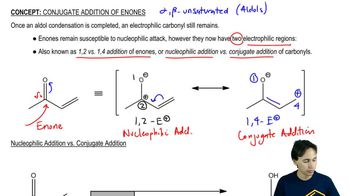
Electrophilic addition is a fundamental reaction mechanism in organic chemistry where an electrophile reacts with a nucleophile, typically involving alkenes. In the presence of strong acids like H₂SO₄, the alkene's double bond acts as a nucleophile, attacking the electrophilic hydrogen, leading to the formation of a carbocation intermediate. This step is crucial for predicting the products of reactions involving alkenes.
Recommended video:
Guided course
09:23
1,2 vs 1,4 Addition

Carbocation Stability

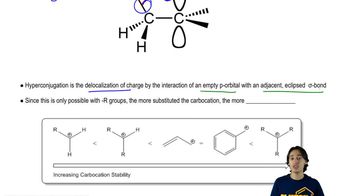
Carbocation stability is a key concept in understanding the outcomes of reactions involving electrophilic addition. Carbocations are positively charged species that can vary in stability based on their structure; tertiary carbocations are more stable than secondary or primary ones due to hyperconjugation and inductive effects. The stability of the carbocation formed during the reaction influences the final product distribution.
Recommended video:
Guided course
05:58
Determining Carbocation Stability

Hydration Reaction

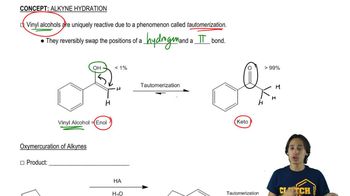
The hydration reaction refers to the addition of water (H₂O) to an alkene, resulting in the formation of an alcohol. Under acidic conditions, such as with H₂SO₄, the alkene first forms a carbocation, which then reacts with water to yield the alcohol product. This process is essential for converting alkenes into alcohols and is a common transformation in organic synthesis.
Recommended video:
Guided course
09:11
Alkyne Hydration