Ch. 8 - Alkenes I: Properties and Electrophilic Additions
Mullins - Organic Chemistry: A Learner Centered Approach 1st Edition
Mullins1st EditionOrganic Chemistry: A Learner Centered ApproachISBN: 9780137566471Not the one you use?Change textbook
Chapter 7, Problem 61g(vi)

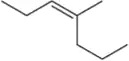
Predict the product(s) that would result when the alkenes shown here are allowed to react under the following conditions: (vi) 1. BH3 2. H2O2, NaOH
(g) Structural representation of alkenes for hydrohalogenation reaction with HBr.

Verified step by step guidance
1
Identify the reaction type: The given reagents (1. BH₃, 2. H₂O₂, NaOH) indicate a hydroboration-oxidation reaction. This reaction is used to convert an alkene into an alcohol.
Understand the regioselectivity: Hydroboration-oxidation follows anti-Markovnikov addition, meaning the hydroxyl group (-OH) will attach to the less substituted carbon of the double bond.
Understand the stereochemistry: The addition of BH₃ occurs in a syn fashion, meaning both the boron and hydrogen add to the same side of the alkene. This stereochemistry is retained during the oxidation step, resulting in a syn addition of the hydroxyl group and hydrogen.
Apply the reaction to the given alkene: Identify the double bond in the alkene structure and determine which carbon is less substituted. Attach the hydroxyl group (-OH) to the less substituted carbon and a hydrogen atom to the more substituted carbon.
Draw the product: After determining the regioselectivity and stereochemistry, draw the final product, ensuring the hydroxyl group is on the less substituted carbon and the stereochemistry reflects syn addition.

Verified video answer for a similar problem:

This video solution was recommended by our tutors as helpful for the problem above.
Video duration:
3m
Was this helpful?

Key Concepts

Here are the essential concepts you must grasp in order to answer the question correctly.

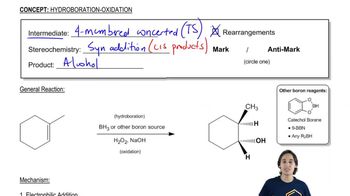
Hydroboration-Oxidation

Hydroboration-oxidation is a two-step reaction process used to convert alkenes into alcohols. In the first step, borane (BH₃) adds across the double bond of the alkene, resulting in a trialkylborane intermediate. The second step involves oxidation with hydrogen peroxide (H₂O₂) in the presence of a base (NaOH), which converts the boron atom into a hydroxyl group, yielding an alcohol.
Recommended video:
Guided course
06:38
General properties of hydroboration-oxidation.

Regioselectivity

Regioselectivity refers to the preference of a chemical reaction to yield one structural isomer over others when multiple products are possible. In hydroboration, the addition of borane occurs in a syn manner, favoring the formation of the less substituted alcohol due to the anti-Markovnikov rule, where the hydroxyl group ends up on the less substituted carbon of the alkene.
Recommended video:
Guided course
05:09
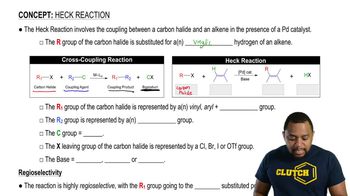
Heck Reaction

Stereochemistry

Stereochemistry is the study of the spatial arrangement of atoms in molecules and how this affects their chemical behavior. In the hydroboration-oxidation process, the syn addition of BH₃ leads to specific stereochemical outcomes in the final alcohol product, which can influence the reactivity and properties of the resulting compound.
Recommended video:
1:38
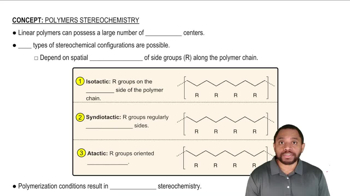
Polymer Stereochemistry Concept 1