
Ch. 8 - Alkenes I: Properties and Electrophilic Additions
Mullins - Organic Chemistry: A Learner Centered Approach 1st Edition
Mullins1st EditionOrganic Chemistry: A Learner Centered ApproachISBN: 9780137566471Not the one you use?Change textbook
Chapter 7, Problem 73

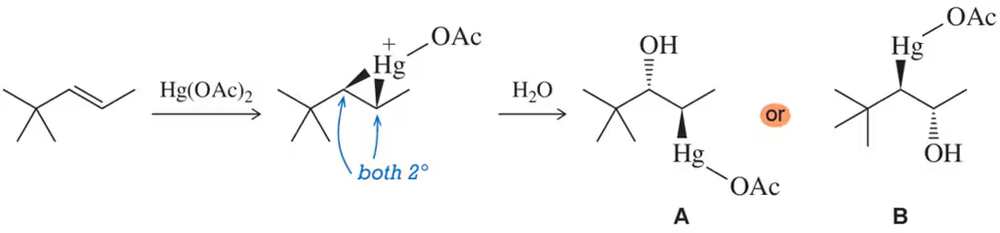
A common situation occurs when both carbons of the mercurinium ion are secondary. In a situation like the one shown, to which carbon would you expect water to add? That is, would you expect to produce A or B? Explain your answer.
Mercurinium ion with secondary carbons; water adds to form either product A or B.

Verified step by step guidance
1
Understand the structure of the mercurinium ion: The mercurinium ion is formed during the oxymercuration-demercuration reaction, where a mercury ion bridges two carbons, creating a three-membered ring. This intermediate is crucial in determining the site of nucleophilic attack.
Identify the nature of the carbons involved: In this problem, both carbons of the mercurinium ion are secondary. Secondary carbons are bonded to two other carbon atoms, which can influence the stability and reactivity of the intermediate.
Consider the steric and electronic effects: Water, as a nucleophile, will attack the more substituted carbon due to steric hindrance and electronic effects. The more substituted carbon is typically more stable and can better accommodate the positive charge developed during the transition state.
Analyze the regioselectivity of the reaction: The addition of water to the mercurinium ion is regioselective, meaning it prefers one carbon over the other. In this case, the nucleophile (water) will likely add to the carbon that can best stabilize the transition state, often the more substituted carbon.
Predict the product formation: Based on the analysis, water will add to the carbon that is more substituted, leading to the formation of the alcohol at that position. This results in the production of one specific product, either A or B, depending on which carbon is more substituted.

Verified video answer for a similar problem:

This video solution was recommended by our tutors as helpful for the problem above.
Video duration:
1m
Was this helpful?

Key Concepts

Here are the essential concepts you must grasp in order to answer the question correctly.

Mercurinium Ion Formation

The mercurinium ion is an intermediate formed during oxymercuration reactions, where mercury adds to an alkene, creating a cyclic structure. This ion stabilizes the positive charge by delocalizing it over the two carbons involved, influencing subsequent nucleophilic attack by water.
Recommended video:
3:39
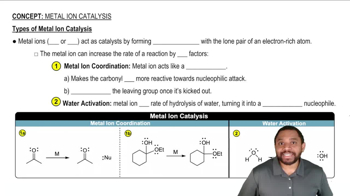
Metal Ion Catalysis Concept 1

Markovnikov's Rule

Markovnikov's Rule predicts the regioselectivity of electrophilic addition reactions, stating that the nucleophile will add to the more substituted carbon. In the context of mercurinium ions, this rule helps determine which carbon water will preferentially attack, leading to the formation of the more stable alcohol product.
Recommended video:
Guided course
03:54
The 18 and 16 Electron Rule

Steric and Electronic Effects

Steric and electronic effects play a crucial role in determining the site of nucleophilic attack. Steric hindrance can prevent water from attacking the more crowded carbon, while electronic effects, such as hyperconjugation, can stabilize the positive charge on the more substituted carbon, guiding the addition of water.
Recommended video:
Guided course
02:53
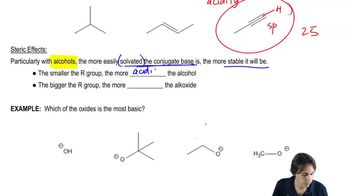
Understanding steric effects.
Related Practice
Textbook Question

In light of your answer to Assessment 8.73, predict the product of the following oxymercuration–reduction reactions, each of which results in a single product. [Don't worry about the absolute stereochemistry, though these reactions are also stereoselective.]

(b) This reaction sequence was used in the synthesis of (+) -lineatin, a monoterpene aggregation pheromone from the female ambrosia beetle Trypodendron lineatum (Org. Lett. 2004, 6, 1449–1452).

1
views
Textbook Question

In light of your answer to Assessment 8.73, predict the product of the following oxymercuration–reduction reactions, each of which results in a single product. [Don't worry about the absolute stereochemistry, though these reactions are also stereoselective.]

(c) Oxymercuration–reduction was used in the stereoselective synthesis of the macrolactone core of neopeltolide, a marine macrolide isolated from a Caribbean sponge that has potent anticancer activity (Org. Lett. 2012, 14, 2346–2349).

2
views
Textbook Question

Predict the product of each of the following hydroboration–oxidation or oxymercuration–reduction reactions used in the modern synthetic organic chemistry literature (modified to use reagents we are used to seeing).

(b) A two-step hydroboration–oxidation was used to prepare a silanediol peptidomimetic as a serine protease inhibitor (Org. Lett. 2012, 14, 4422–4425).

1
views
Textbook Question

Predict the product of each of the following hydroboration–oxidation or oxymercuration–reduction reactions used in the modern synthetic organic chemistry literature (modified to use reagents we are used to seeing).

(c) A similar sequence was featured in the synthesis of muricadienin, a proposed precursor in the biosynthesis of solamin (Org. Lett. 2014, 16, 5886–5889).

2
views
Textbook Question

The formation of five-membered ring ethers is an important goal in synthetic organic chemistry because tetrahydrofurans are contained within a number of antitumor natural products. Toward that end, a one-pot synthesis of a bis-THF containing compound was developed (Eur. J. Org. Chem. 2010, 6263–6268). Suggest a mechanism for this transformation.

3
views
Textbook Question

If you react carvone with a single equivalent of HBr, only one product is produced, even though carvone has two carbon–carbon double bonds. Explain this observation.

1
views