
Ch. 8 - Alkenes I: Properties and Electrophilic Additions
Mullins - Organic Chemistry: A Learner Centered Approach 1st Edition
Mullins1st EditionOrganic Chemistry: A Learner Centered ApproachISBN: 9780137566471Not the one you use?Change textbook
Chapter 7, Problem 71b

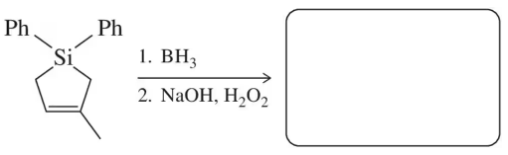
Predict the product of each of the following hydroboration–oxidation or oxymercuration–reduction reactions used in the modern synthetic organic chemistry literature (modified to use reagents we are used to seeing).
(b) A two-step hydroboration–oxidation was used to prepare a silanediol peptidomimetic as a serine protease inhibitor (Org. Lett. 2012, 14, 4422–4425).

Verified step by step guidance
1
Step 1: Recognize the reaction type. This is a hydroboration–oxidation reaction, which involves the addition of water across a double bond in an anti-Markovnikov fashion. The reagents used are borane (BH₃) followed by hydrogen peroxide (H₂O₂) in a basic solution (NaOH).
Step 2: Identify the alkene in the molecule. The double bond in the cyclic structure is the site of the reaction. The silicon atom and phenyl groups (Ph) are not directly involved in the reaction but are part of the molecule's framework.
Step 3: Predict the regioselectivity. Hydroboration–oxidation adds the hydroxyl group (-OH) to the less substituted carbon of the double bond, following anti-Markovnikov selectivity. The hydrogen (H) is added to the more substituted carbon.
Step 4: Consider stereochemistry. Hydroboration–oxidation proceeds with syn addition, meaning the hydrogen and hydroxyl group are added to the same face of the double bond. This stereochemical outcome should be reflected in the product.
Step 5: Draw the product. Replace the double bond with a single bond, and add the hydroxyl group (-OH) to the less substituted carbon and a hydrogen atom to the more substituted carbon. Ensure the stereochemistry is consistent with syn addition.

Verified video answer for a similar problem:

This video solution was recommended by our tutors as helpful for the problem above.
Video duration:
4m
Was this helpful?

Key Concepts

Here are the essential concepts you must grasp in order to answer the question correctly.

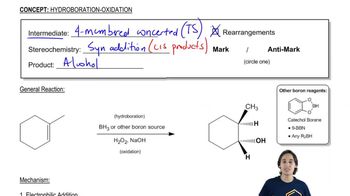
Hydroboration-Oxidation

Hydroboration-oxidation is a two-step reaction process used to convert alkenes into alcohols. In the first step, an alkene reacts with borane (BH3) to form an organoborane intermediate, which is then oxidized in the second step using hydrogen peroxide (H2O2) and a base, typically sodium hydroxide (NaOH). This reaction is notable for its anti-Markovnikov selectivity, meaning that the hydroxyl group is added to the less substituted carbon of the alkene.
Recommended video:
Guided course
06:38
General properties of hydroboration-oxidation.

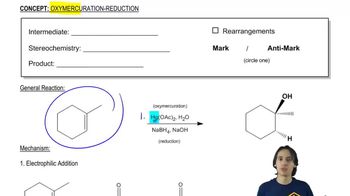
Oxymercuration-Reduction

Oxymercuration-reduction is another method for converting alkenes to alcohols, involving the addition of mercuric acetate (Hg(OAc)2) to the alkene, followed by reduction with sodium borohydride (NaBH4). This reaction proceeds through a mercurinium ion intermediate, allowing for Markovnikov addition of the hydroxyl group. It is particularly useful for synthesizing alcohols with high regioselectivity and minimal rearrangement.
Recommended video:
Guided course
05:
General properties of oxymercuration-reduction.

Regioselectivity

Regioselectivity refers to the preference of a chemical reaction to yield one structural isomer over others when multiple possibilities exist. In the context of hydroboration-oxidation and oxymercuration-reduction, understanding regioselectivity is crucial for predicting the major product formed from an alkene. The reactions favor specific pathways that lead to the formation of products with distinct functional groups positioned at specific carbon atoms, which is essential for designing synthetic routes in organic chemistry.
Recommended video:
Guided course
05:09
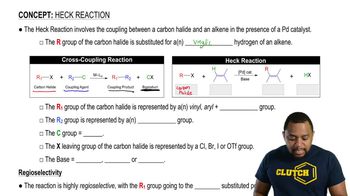
Heck Reaction
Related Practice
Textbook Question

In light of your answer to Assessment 8.73, predict the product of the following oxymercuration–reduction reactions, each of which results in a single product. [Don't worry about the absolute stereochemistry, though these reactions are also stereoselective.]

(b) This reaction sequence was used in the synthesis of (+) -lineatin, a monoterpene aggregation pheromone from the female ambrosia beetle Trypodendron lineatum (Org. Lett. 2004, 6, 1449–1452).

1
views
Textbook Question

When using sulfuric acid, but in the absence of other nucleophiles like water or bromide ion, less stable alkenes can be isomerized to their more stable isomer. Provide a mechanism for these acid-catalyzed isomerization reactions. [This is one illustration of the principle of microscopic reversibility.]

(b)

1
views
Textbook Question

A common situation occurs when both carbons of the mercurinium ion are secondary. In a situation like the one shown, to which carbon would you expect water to add? That is, would you expect to produce A or B? Explain your answer.

2
views
Textbook Question

When using sulfuric acid, but in the absence of other nucleophiles like water or bromide ion, less stable alkenes can be isomerized to their more stable isomer. Provide a mechanism for these acid-catalyzed isomerization reactions. [This is one illustration of the principle of microscopic reversibility.]

(c)

1
views
Textbook Question

Predict the product of each of the following hydroboration–oxidation or oxymercuration–reduction reactions used in the modern synthetic organic chemistry literature (modified to use reagents we are used to seeing).

(c) A similar sequence was featured in the synthesis of muricadienin, a proposed precursor in the biosynthesis of solamin (Org. Lett. 2014, 16, 5886–5889).

2
views
Textbook Question

If you react carvone with a single equivalent of HBr, only one product is produced, even though carvone has two carbon–carbon double bonds. Explain this observation.

1
views