Ch. 6 - Stereoisomerism: Arrangement of Atoms in Space
Mullins - Organic Chemistry: A Learner Centered Approach 1st Edition
Mullins1st EditionOrganic Chemistry: A Learner Centered ApproachISBN: 9780137566471Not the one you use?Change textbook
Chapter 5, Problem 5a

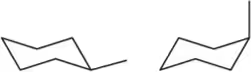
What type of isomerism is indicated by each of the following pairs of molecules? Be as specific as possible.
(a) Two molecular structures illustrating different types of isomerism, highlighting their distinct arrangements.

Verified step by step guidance
1
Step 1: Understand the concept of isomerism. Isomerism occurs when two or more compounds have the same molecular formula but differ in the arrangement of atoms or spatial orientation. The two main types of isomerism are structural isomerism and stereoisomerism.
Step 2: Analyze the molecular structures of the given pair of molecules. Look for differences in connectivity of atoms (structural isomerism) or differences in spatial arrangement (stereoisomerism).
Step 3: If the connectivity of atoms is different, classify the isomerism as structural isomerism. Further, identify the specific type, such as chain isomerism, position isomerism, or functional group isomerism.
Step 4: If the connectivity is the same but the spatial arrangement differs, classify the isomerism as stereoisomerism. Further, determine whether it is geometric (cis-trans) isomerism or optical isomerism based on the presence of chiral centers or restricted rotation.
Step 5: For each pair of molecules, apply the above analysis to identify the specific type of isomerism. Ensure to justify your reasoning based on the structural or spatial differences observed.

Verified video answer for a similar problem:

This video solution was recommended by our tutors as helpful for the problem above.
Video duration:
1m
Was this helpful?

Key Concepts

Here are the essential concepts you must grasp in order to answer the question correctly.

Isomerism

Isomerism refers to the phenomenon where two or more compounds have the same molecular formula but different structural or spatial arrangements of atoms. This can lead to variations in physical and chemical properties, making isomers an important concept in organic chemistry.
Recommended video:
Guided course
06:47
Monosaccharides - D and L Isomerism

Structural Isomerism

Structural isomerism occurs when isomers differ in the connectivity of their atoms. This can include variations such as chain isomerism, where the carbon skeleton differs, and functional group isomerism, where the functional groups are different, leading to distinct chemical behaviors.
Recommended video:
Guided course
06:47
Monosaccharides - D and L Isomerism

Stereoisomerism

Stereoisomerism is a type of isomerism where isomers have the same connectivity of atoms but differ in the spatial arrangement of those atoms. This includes geometric isomerism (cis-trans) and optical isomerism (enantiomers), which can significantly affect the properties and reactivity of the molecules.
Recommended video:
Guided course
01:58
Determining when molecules are stereoisomers.