Ch. 6 - Stereoisomerism: Arrangement of Atoms in Space
Mullins - Organic Chemistry: A Learner Centered Approach 1st Edition
Mullins1st EditionOrganic Chemistry: A Learner Centered ApproachISBN: 9780137566471Not the one you use?Change textbook
Chapter 5, Problem 5b

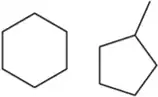
What type of isomerism is indicated by each of the following pairs of molecules? Be as specific as possible.
(b) Two molecular structures: a hexagon representing cyclohexane and a pentagon with a branch indicating a constitutional isomer.

Verified step by step guidance
1
Step 1: Observe the two molecular structures provided in the image. The first molecule is a cyclopentane, a five-membered ring, while the second molecule is a methylcyclobutane, a four-membered ring with a methyl group attached.
Step 2: Recall the concept of structural isomerism. Structural isomers have the same molecular formula but differ in the connectivity of atoms within the molecule.
Step 3: Determine the molecular formula for both molecules. Cyclopentane has the formula C5H10, and methylcyclobutane also has the formula C5H10. This confirms that they are structural isomers.
Step 4: Analyze the specific type of structural isomerism. These molecules differ in the arrangement of their carbon atoms: one forms a five-membered ring, while the other forms a four-membered ring with a substituent. This is an example of ring-chain isomerism, a subtype of structural isomerism.
Step 5: Conclude that the type of isomerism indicated by the pair of molecules is ring-chain isomerism, as they differ in the cyclic structure and substituent arrangement while maintaining the same molecular formula.

Verified video answer for a similar problem:

This video solution was recommended by our tutors as helpful for the problem above.
Video duration:
2m
Was this helpful?

Key Concepts

Here are the essential concepts you must grasp in order to answer the question correctly.

Isomerism

Isomerism refers to the phenomenon where two or more compounds have the same molecular formula but different structural arrangements or spatial orientations. This can lead to distinct physical and chemical properties, making isomerism a crucial concept in organic chemistry.
Recommended video:
Guided course
06:47
Monosaccharides - D and L Isomerism

Constitutional Isomers

Constitutional isomers are a type of isomerism where compounds differ in the connectivity of their atoms. This means that the atoms are bonded together in different ways, resulting in distinct structures, as seen in the provided molecular structures of a pentagon and a square.
Recommended video:
Guided course
01:10
What is a constitutional isomer?

Ring vs. Chain Structures

In organic chemistry, ring structures (like cyclopentane) and chain structures (like butane) can exhibit isomerism. The difference in the arrangement of carbon atoms in a ring versus a linear chain can lead to different isomers, highlighting the importance of understanding molecular geometry in isomer classification.
Recommended video:
Guided course
06:14
Side-Chain Halogenations