
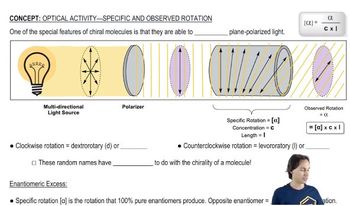
Using a 1.0-cm polarimeter cell and a solution prepared by dissolving 2.54 g of glucose in 1 L of H₂O, the specific rotation of d-glucose was calculated to be +52.7° at 20 °C using the sodium D line as the source of light. What was the observed rotation of the solution?

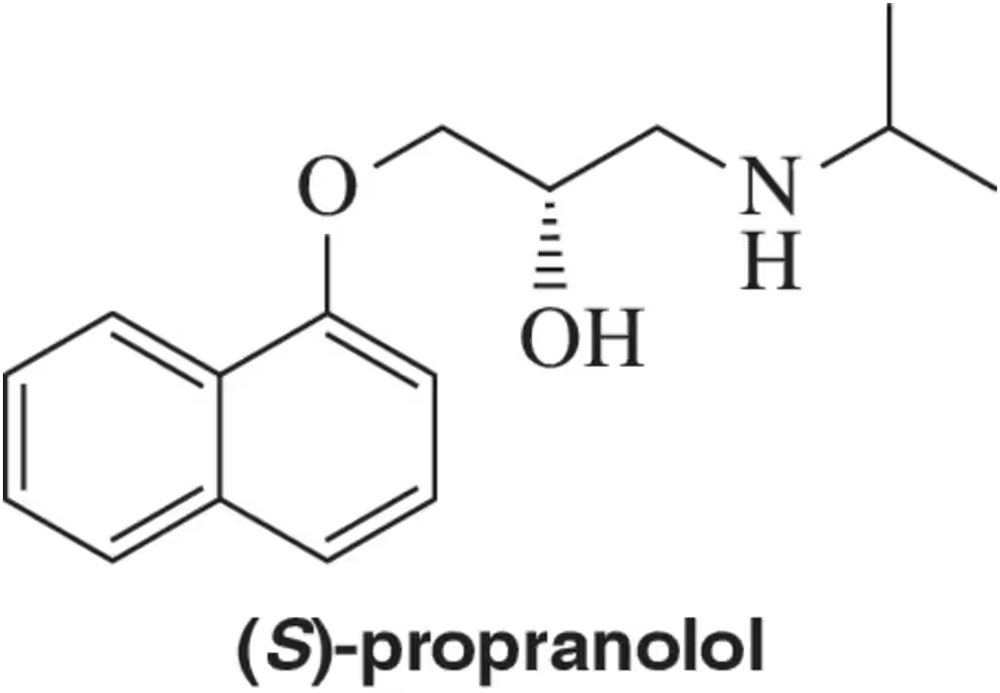
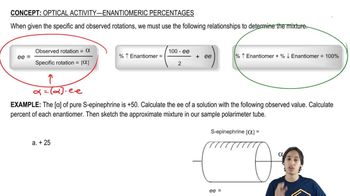
(S)-Propranolol, a drug used for the treatment of anxiety, has a specific rotation of -25.5° . Attempting to prepare it in enantiopure form, a chemist produced a compound that gave a specific rotation of -18.3° . What is the ratio of (S)- to (R)-propranolol produced by the chemist?

Verified step by step guidance
Verified video answer for a similar problem:
Key Concepts
Specific Rotation
Enantiomers
Optical Purity
For the molecules shown,
(i) count the number of stereocenters present and
(ii) draw all possible stereoisomers.
(iii) Identify the relationships between stereoisomers as enantiomers or diastereomers.
(b)
Imagine a sample that is enriched in the R enantiomer. If the % ee of the sample is 83%,
(a) what percent of the mixture is racemic?
(b) What is the ratio of R to S?
(R)-Selegiline, a monoamine oxidase (MAO) inactivator, was approved by the FDA in 1989 for the treatment of Parkinson's disease. In pure form, it has a specific rotation, [α]²⁰D = - 11.0°. What is the expected specific rotation of a mixture containing 64% S and 36% R?
Cholesterol (50 mg) was dissolved in 10 mL of chloroform and placed in a 1.0-cm polarimeter cell. This solution produced an observed rotation (using the sodium D line at 20°C ) of - 1.58° . What is the specific rotation of cholesterol?
For the molecules shown,
(i) count the number of stereocenters present and
(ii) draw all possible stereoisomers.
(iii) Identify the relationships between stereoisomers as enantiomers or diastereomers.
(a)
