
Ch. 6 - Stereoisomerism: Arrangement of Atoms in Space
Mullins - Organic Chemistry: A Learner Centered Approach 1st Edition
Mullins1st EditionOrganic Chemistry: A Learner Centered ApproachISBN: 9780137566471Not the one you use?Change textbook
Chapter 5, Problem 34

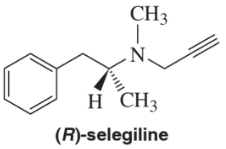
(R)-Selegiline, a monoamine oxidase (MAO) inactivator, was approved by the FDA in 1989 for the treatment of Parkinson's disease. In pure form, it has a specific rotation, [α]²⁰D = - 11.0°. What is the expected specific rotation of a mixture containing 64% S and 36% R?

Verified step by step guidance
1
Step 1: Recall that specific rotation ([α]) is a property of chiral compounds and is dependent on the enantiomeric composition of the mixture. A racemic mixture (50% R and 50% S) has a specific rotation of 0° because the rotations of the two enantiomers cancel each other out.
Step 2: Identify the specific rotation of the pure (R)-enantiomer, which is given as [α]²⁰D = -11.0°. The (S)-enantiomer will have the opposite specific rotation, [α]²⁰D = +11.0°, because enantiomers rotate plane-polarized light in equal magnitude but opposite directions.
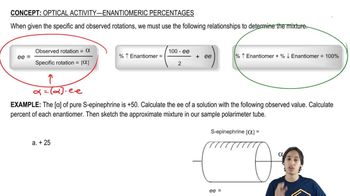
Step 3: Determine the enantiomeric excess (ee) of the mixture. The mixture contains 64% S and 36% R. The enantiomeric excess is calculated using the formula: ee = |%S - %R|. Substituting the values: ee = |64 - 36| = 28%.
Step 4: Calculate the specific rotation of the mixture using the formula: [α]mixture = ee × [α]pure enantiomer. Since the mixture is enriched in the S-enantiomer, the specific rotation will be positive. Substitute the values: [α]mixture = 0.28 × (+11.0°).
Step 5: Combine the contributions of both enantiomers to the specific rotation of the mixture. The remaining 72% of the mixture (not part of the enantiomeric excess) is racemic and contributes 0° to the specific rotation. Therefore, the final specific rotation of the mixture is determined by the enantiomeric excess contribution.

Verified video answer for a similar problem:

This video solution was recommended by our tutors as helpful for the problem above.
Video duration:
5m
Was this helpful?

Key Concepts

Here are the essential concepts you must grasp in order to answer the question correctly.

Specific Rotation

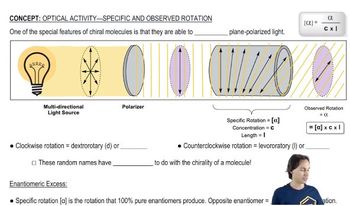
Specific rotation is a property of chiral compounds that quantifies the degree to which they rotate plane-polarized light. It is defined as the observed rotation of light at a specific wavelength and temperature, normalized by the concentration of the solution and the path length of the light. This property is crucial for distinguishing between enantiomers and understanding their optical activity.
Recommended video:
Guided course
05:43
Specific rotation vs. observed rotation.

Enantiomers

Enantiomers are pairs of molecules that are non-superimposable mirror images of each other, often differing in their interaction with polarized light. In the case of (R)-Selegiline and its (S) counterpart, they exhibit different specific rotations due to their chiral nature. Understanding the relationship between enantiomers is essential for predicting the optical activity of mixtures.
Recommended video:
Guided course
03:23
How to solve for the percentage of each enantiomer.

Weighted Average of Specific Rotation

The specific rotation of a mixture of enantiomers can be calculated using a weighted average based on the proportions of each enantiomer present. This involves multiplying the specific rotation of each enantiomer by its respective fraction in the mixture and summing these values. This concept is vital for determining the expected specific rotation of a racemic or non-racemic mixture.
Recommended video:
Guided course
05:43
Specific rotation vs. observed rotation.