Ch. 6 - Stereoisomerism: Arrangement of Atoms in Space
Mullins - Organic Chemistry: A Learner Centered Approach 1st Edition
Mullins1st EditionOrganic Chemistry: A Learner Centered ApproachISBN: 9780137566471Not the one you use?Change textbook
Chapter 5, Problem 7.17

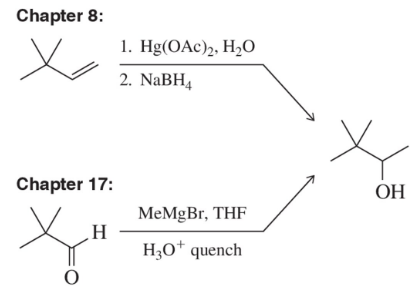
In Chapters 8 and 17 we learn two reactions for the synthesis of the alcohol shown. (a) Show a mechanism for each of the reactions. (b) If you were designing a synthetic route, which would be considered more sustainable? Consider all factors. [Assume the starting organic molecules are equally green.]

Verified step by step guidance
1
Step 1: Analyze the reaction from Chapter 8, which involves oxymercuration-demercuration. The starting alkene undergoes oxymercuration with mercuric acetate (Hg(OAc)₂) and water, forming a mercurinium ion intermediate. This intermediate is then attacked by water, leading to the formation of an organomercury alcohol. Finally, sodium borohydride (NaBH₄) is used to reduce the organomercury compound, replacing the mercury with a hydrogen atom, resulting in the alcohol.
Step 2: Examine the reaction from Chapter 17, which involves the Grignard reaction. The starting ketone reacts with methylmagnesium bromide (MeMgBr) in tetrahydrofuran (THF) to form a tertiary alcohol. The Grignard reagent acts as a nucleophile, attacking the electrophilic carbonyl carbon of the ketone, forming a new carbon-carbon bond. The reaction is quenched with an acid, typically H₃O⁺, to protonate the alkoxide intermediate, yielding the alcohol.
Step 3: Compare the sustainability of both synthetic routes. Consider factors such as the use of toxic reagents, energy consumption, waste generation, and atom economy. The oxymercuration-demercuration method uses mercury, which is toxic and poses environmental hazards. The Grignard reaction, while requiring careful handling of reagents, does not involve toxic metals and may be considered more sustainable.
Step 4: Evaluate the atom economy of each reaction. Atom economy is a measure of how well a reaction utilizes its reactants to form the desired product. The Grignard reaction typically has a higher atom economy because it directly forms the alcohol without the need for additional reduction steps.
Step 5: Consider the overall efficiency and practicality of each method in a synthetic route. The Grignard reaction is often favored for its straightforward mechanism and ability to form carbon-carbon bonds, which is crucial in organic synthesis. However, the choice of method may depend on specific reaction conditions and the availability of reagents.

Verified video answer for a similar problem:

This video solution was recommended by our tutors as helpful for the problem above.
Video duration:
14m
Was this helpful?

Key Concepts

Here are the essential concepts you must grasp in order to answer the question correctly.

Reaction Mechanisms

A reaction mechanism is a step-by-step description of how reactants transform into products in a chemical reaction. It outlines the sequence of bond-breaking and bond-forming events, providing insight into the intermediates and transition states involved. Understanding mechanisms is crucial for predicting reaction outcomes and designing synthetic pathways.
Recommended video:
Guided course
02:16
Heck Reaction Mechanism

Sustainability in Organic Synthesis

Sustainability in organic synthesis refers to the design of chemical processes that minimize environmental impact and resource consumption. This includes using renewable feedstocks, reducing waste, and employing energy-efficient methods. Evaluating the sustainability of a synthetic route involves considering factors like the use of hazardous materials, energy requirements, and overall ecological footprint.
Recommended video:
1:16
Synthesis of Amino Acids: Strecker Synthesis Example 1

Green Chemistry Principles

Green chemistry principles are guidelines aimed at reducing the environmental and health impacts of chemical processes. These principles promote the use of safer solvents, the reduction of hazardous substances, and the design of processes that maximize atom economy. Familiarity with these principles is essential for assessing the sustainability of different synthetic routes in organic chemistry.
Recommended video:
Guided course
00:28
Introduction to General Chemistry Review