Ch. 6 - Stereoisomerism: Arrangement of Atoms in Space
Mullins - Organic Chemistry: A Learner Centered Approach 1st Edition
Mullins1st EditionOrganic Chemistry: A Learner Centered ApproachISBN: 9780137566471Not the one you use?Change textbook
Chapter 5, Problem 8a

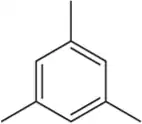
Identify all planes of symmetry in the following molecules/conformations, if any.
(a)

Verified step by step guidance
1
Step 1: Understand the concept of a plane of symmetry. A plane of symmetry divides a molecule into two mirror-image halves. This means that if you were to fold the molecule along this plane, both halves would overlap perfectly.
Step 2: Analyze the molecular structure provided in part (a). Look for elements of symmetry in the molecule, such as identical groups or atoms arranged in a way that suggests a mirror plane.
Step 3: Visualize or draw the molecule in 3D if possible. This helps in identifying planes of symmetry more effectively. Consider rotating the molecule to view it from different angles.
Step 4: Check for symmetry in different planes (e.g., horizontal, vertical, diagonal). For each plane, determine if the molecule can be divided into two identical halves.
Step 5: Confirm the presence or absence of planes of symmetry by ensuring that all atoms and groups on one side of the plane have identical counterparts on the other side. If no such plane exists, the molecule lacks a plane of symmetry.

Verified video answer for a similar problem:

This video solution was recommended by our tutors as helpful for the problem above.
Video duration:
36s
Was this helpful?

Key Concepts

Here are the essential concepts you must grasp in order to answer the question correctly.

Symmetry in Molecules

Symmetry in molecules refers to the balanced and proportionate arrangement of atoms in a molecule. It can be classified into different types, such as rotational symmetry, mirror planes, and inversion centers. Understanding symmetry is crucial for predicting molecular behavior, reactivity, and properties, as symmetrical molecules often exhibit unique characteristics.
Recommended video:
Guided course
00:25
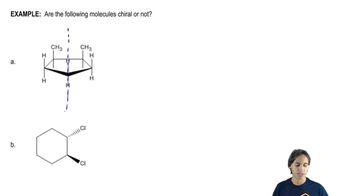
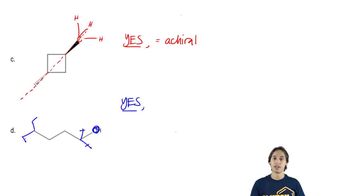
Determining Chirality with Plane of Symmetry

Planes of Symmetry

A plane of symmetry is an imaginary plane that divides a molecule into two mirror-image halves. If a molecule has one or more planes of symmetry, it is considered symmetrical. Identifying these planes helps in determining the chirality of a molecule, which is essential in stereochemistry and understanding how molecules interact in biological systems.
Recommended video:
Guided course
02:58
Determining Chirality with Plane of Symmetry

Chirality

Chirality is a property of a molecule that makes it non-superimposable on its mirror image, much like left and right hands. Molecules that lack a plane of symmetry are often chiral and can exist as enantiomers, which are pairs of molecules that are mirror images of each other. Chirality is significant in organic chemistry, particularly in drug design, as different enantiomers can have vastly different biological effects.
Recommended video:
Guided course
05:10
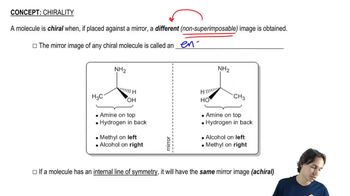
What is chirality?