Ch. 6 - Stereoisomerism: Arrangement of Atoms in Space
Mullins - Organic Chemistry: A Learner Centered Approach 1st Edition
Mullins1st EditionOrganic Chemistry: A Learner Centered ApproachISBN: 9780137566471Not the one you use?Change textbook
Chapter 5, Problem 14d

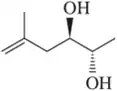
For each of the following chiral molecules, obtain the enantiomer (i) by drawing the nonsuperimposable mirror image and (ii) by switching the spatial orientation at each asymmetric center. Confirm (possibly using models) that the structures you drew for (i) and (ii) are the same.
(d) Chiral molecule structure with hydroxyl groups, illustrating asymmetric centers for enantiomer comparison.

Verified step by step guidance
1
Identify the chiral center(s) in the given molecule. A chiral center is typically a carbon atom bonded to four different groups. Analyze the structure carefully to locate all such centers.
To obtain the enantiomer by drawing the nonsuperimposable mirror image (step i), imagine a mirror placed next to the molecule. Reflect each group attached to the chiral center(s) across the mirror plane. Ensure that the spatial arrangement of the groups is reversed, but the connectivity remains the same.
To obtain the enantiomer by switching the spatial orientation at each asymmetric center (step ii), invert the positions of any two groups attached to each chiral center. This effectively reverses the configuration at the chiral center, creating the enantiomer.
Compare the structures obtained in steps (i) and (ii). Confirm that they are identical by checking the spatial arrangement of the groups around each chiral center. You can use molecular models or visualization software to verify this.
Understand that enantiomers are nonsuperimposable mirror images of each other. This means that even though they have the same connectivity of atoms, their three-dimensional arrangements are opposite, leading to different interactions with polarized light and chiral environments.

Verified video answer for a similar problem:

This video solution was recommended by our tutors as helpful for the problem above.
Video duration:
1m
Was this helpful?

Key Concepts

Here are the essential concepts you must grasp in order to answer the question correctly.

Chirality

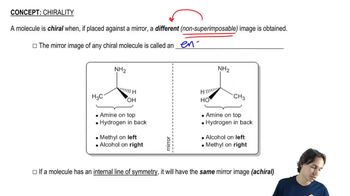
Chirality refers to the geometric property of a molecule that makes it non-superimposable on its mirror image. Molecules that possess chirality typically have one or more asymmetric carbon atoms, leading to two distinct forms known as enantiomers. These enantiomers exhibit different optical activities and can have different biological activities, making chirality a crucial concept in organic chemistry.
Recommended video:
Guided course
05:10
What is chirality?

Enantiomers

Enantiomers are a pair of chiral molecules that are mirror images of each other. They have identical physical properties, such as melting and boiling points, but differ in how they interact with polarized light and with other chiral substances. Understanding enantiomers is essential for predicting the behavior of chiral compounds in chemical reactions and biological systems.
Recommended video:
Guided course
03:23
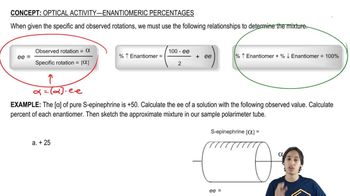
How to solve for the percentage of each enantiomer.

Stereochemistry

Stereochemistry is the study of the spatial arrangement of atoms in molecules and how this arrangement affects their chemical behavior. It encompasses concepts such as chirality, enantiomers, and diastereomers. In the context of the question, understanding stereochemistry is vital for accurately drawing the nonsuperimposable mirror images and switching the spatial orientation at asymmetric centers to obtain the correct enantiomer.
Recommended video:
1:38
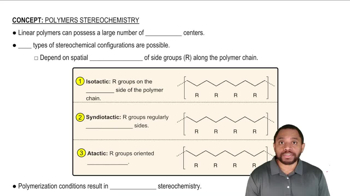
Polymer Stereochemistry Concept 1