Ch. 6 - Stereoisomerism: Arrangement of Atoms in Space
Mullins - Organic Chemistry: A Learner Centered Approach 1st Edition
Mullins1st EditionOrganic Chemistry: A Learner Centered ApproachISBN: 9780137566471Not the one you use?Change textbook
Chapter 5, Problem 15

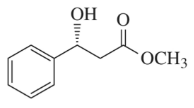
Draw the mirror image of the following molecule. Then, using the mirror image generated, switch the spatial orientation at the asymmetric center. Is the final structure the enantiomer of the original? If not, what is it?

Verified step by step guidance
1
Step 1: Identify the asymmetric center in the molecule. The asymmetric center is the carbon atom bonded to four different groups: the hydroxyl group (-OH), the benzene ring, the methoxy group (-OCH3), and the hydrogen atom.
Step 2: Draw the mirror image of the molecule. To do this, reflect the spatial arrangement of the groups around the asymmetric center. For example, if the hydroxyl group (-OH) is on a wedge (coming out of the plane), it will now be on a dash (going into the plane) in the mirror image.
Step 3: Switch the spatial orientation at the asymmetric center in the mirror image. This involves interchanging the positions of two groups around the asymmetric center. For instance, swap the positions of the hydroxyl group (-OH) and the hydrogen atom.
Step 4: Compare the final structure obtained after switching the spatial orientation with the original molecule. Determine if the final structure is the enantiomer of the original molecule or if it is identical to the original molecule.
Step 5: Analyze the relationship between the original molecule and the final structure. If the final structure is not the enantiomer, it could be a diastereomer or the same molecule depending on the spatial arrangement of the groups.

Verified video answer for a similar problem:

This video solution was recommended by our tutors as helpful for the problem above.
Video duration:
2m
Was this helpful?

Key Concepts

Here are the essential concepts you must grasp in order to answer the question correctly.

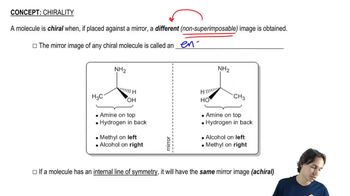
Chirality

Chirality refers to the property of a molecule that makes it non-superimposable on its mirror image. This occurs when a carbon atom is bonded to four different substituents, creating an asymmetric center. Molecules that exhibit chirality can exist as two distinct forms, known as enantiomers, which have identical physical properties but differ in their interaction with polarized light and biological systems.
Recommended video:
Guided course
05:10
What is chirality?

Enantiomers

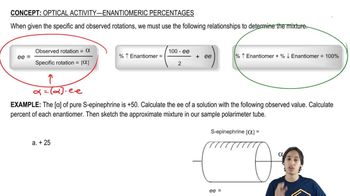
Enantiomers are a pair of chiral molecules that are mirror images of each other. They have the same molecular formula and connectivity of atoms but differ in the spatial arrangement of their atoms. Enantiomers can exhibit different chemical behaviors, particularly in chiral environments, such as biological systems, making their distinction crucial in fields like pharmacology.
Recommended video:
Guided course
03:23
How to solve for the percentage of each enantiomer.

Stereochemistry

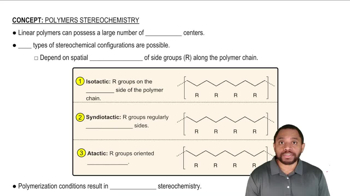
Stereochemistry is the study of the spatial arrangement of atoms in molecules and how this arrangement affects their chemical properties and reactions. It encompasses concepts such as chirality, enantiomers, and diastereomers. Understanding stereochemistry is essential for predicting the behavior of molecules in reactions and their interactions with other chiral substances.
Recommended video:
1:38
Polymer Stereochemistry Concept 1