Ch. 5 - Chemical Reaction Analysis: Thermodynamics and Kinetics
Mullins - Organic Chemistry: A Learner Centered Approach 1st Edition
Mullins1st EditionOrganic Chemistry: A Learner Centered ApproachISBN: 9780137566471Not the one you use?Change textbook
Chapter 4, Problem 4b

Which is the most acidic compound in each pair?
(b) HF vs. HCl

Verified step by step guidance
1
Step 1: Understand the concept of acidity. Acidity is determined by the ability of a compound to donate a proton (H⁺). The strength of an acid is influenced by factors such as bond strength and the stability of the conjugate base formed after donating a proton.
Step 2: Compare the bond strength of HF and HCl. The bond strength between hydrogen and fluorine (H-F) is stronger than the bond strength between hydrogen and chlorine (H-Cl). This is because fluorine is smaller and forms a shorter, stronger bond with hydrogen.
Step 3: Analyze the stability of the conjugate base. After donating a proton, HF forms F⁻ and HCl forms Cl⁻. Chloride ion (Cl⁻) is larger and can better distribute the negative charge compared to fluoride ion (F⁻), making Cl⁻ more stable.
Step 4: Relate bond strength and conjugate base stability to acidity. A weaker bond to hydrogen makes it easier for the compound to donate a proton, and a more stable conjugate base increases the likelihood of proton donation. These factors together determine the relative acidity of HF and HCl.
Step 5: Conclude based on the analysis. Since HCl has a weaker H-Cl bond and forms a more stable conjugate base (Cl⁻), it is more acidic than HF.

Verified video answer for a similar problem:

This video solution was recommended by our tutors as helpful for the problem above.
Video duration:
2m
Was this helpful?

Key Concepts

Here are the essential concepts you must grasp in order to answer the question correctly.

Acidity and pKa

Acidity refers to the ability of a compound to donate protons (H+ ions) in a solution. The strength of an acid is often measured using the pKa value, where a lower pKa indicates a stronger acid. Understanding the pKa values of different acids helps in comparing their acidity and predicting their behavior in chemical reactions.
Recommended video:
Guided course
07:45
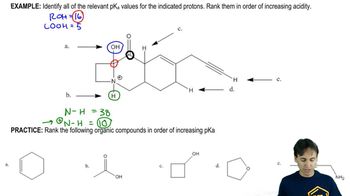
Identifying pKa values

Bond Strength and Electronegativity

The strength of the bond between hydrogen and the other atom in an acid influences its acidity. In binary acids like HF and HCl, the bond strength decreases down the group in the periodic table. Additionally, electronegativity plays a role; as the electronegativity of the atom bonded to hydrogen increases, the bond becomes more polarized, facilitating proton donation.
Recommended video:
Guided course
1:47
Electronegativity

Comparative Acidity of Hydrohalic Acids

Hydrohalic acids (HF, HCl, HBr, HI) exhibit varying acidity based on the halogen involved. HCl is generally more acidic than HF due to the weaker H-Cl bond compared to the H-F bond, which is stronger and less likely to release a proton. This comparative analysis is essential for determining which compound is more acidic in pairs of hydrohalic acids.
Recommended video:
Guided course
02:41
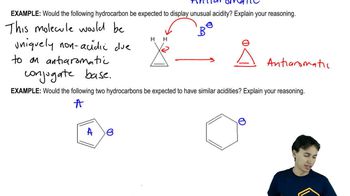
Comparing hydrocarbon acidity