Ch. 5 - Chemical Reaction Analysis: Thermodynamics and Kinetics
Mullins - Organic Chemistry: A Learner Centered Approach 1st Edition
Mullins1st EditionOrganic Chemistry: A Learner Centered ApproachISBN: 9780137566471Not the one you use?Change textbook
Chapter 4, Problem 6a

Provide a reasonable arrow-pushing mechanism for the following Lewis acid–Lewis base reactions.
(a) Lewis acid-base reaction showing the interaction between ammonia and boron trifluoride, resulting in a complex formation.

Verified step by step guidance
1
Identify the Lewis base and Lewis acid in the reaction. In this case, NH₃ acts as the Lewis base because it has a lone pair of electrons on the nitrogen atom, and BF₃ acts as the Lewis acid because boron is electron-deficient and can accept a pair of electrons.
Recognize the interaction between the Lewis base and Lewis acid. The lone pair of electrons on the nitrogen atom in NH₃ will be donated to the empty p-orbital of boron in BF₃.
Draw the arrow-pushing mechanism. Use a curved arrow to show the movement of the lone pair of electrons from the nitrogen atom in NH₃ to the boron atom in BF₃.
After the electron donation, a coordinate covalent bond is formed between the nitrogen atom and the boron atom. This results in the formation of the complex H₃N⁺—BF₃⁻.
Indicate the charges in the product. The nitrogen atom in NH₃ gains a positive charge due to the donation of its lone pair, and the boron atom in BF₃ gains a negative charge due to the acceptance of electrons.

Verified video answer for a similar problem:

This video solution was recommended by our tutors as helpful for the problem above.
Was this helpful?

Key Concepts

Here are the essential concepts you must grasp in order to answer the question correctly.

Lewis Acids and Bases

Lewis acids are species that can accept an electron pair, while Lewis bases are species that can donate an electron pair. In the reaction shown, BF3 acts as a Lewis acid by accepting an electron pair from the Lewis base, ammonia (NH3), resulting in the formation of a coordinate covalent bond.
Recommended video:
Guided course
02:49
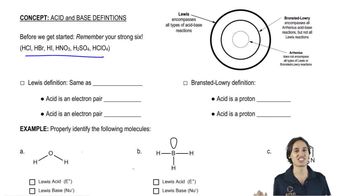
The Lewis definition of acids and bases.

Arrow-Pushing Mechanism

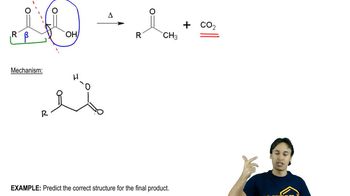
The arrow-pushing mechanism is a method used to illustrate the movement of electrons during chemical reactions. In Lewis acid-base reactions, arrows indicate the flow of electron pairs from the Lewis base to the Lewis acid, helping to visualize the formation of new bonds and the changes in charge.
Recommended video:
Guided course
04:32
General Mechanism

Formation of Adducts

An adduct is a complex formed from the reaction of a Lewis acid and a Lewis base. In this case, the product H3N–BF3 represents an adduct where the nitrogen atom of ammonia donates its lone pair to the boron atom of BF3, resulting in a stable compound that can be analyzed further for its properties.
Recommended video:
Guided course
02:26
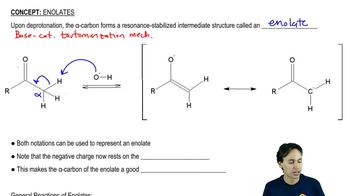
Formation of Enolates