Ch. 5 - Chemical Reaction Analysis: Thermodynamics and Kinetics
Mullins - Organic Chemistry: A Learner Centered Approach 1st Edition
Mullins1st EditionOrganic Chemistry: A Learner Centered ApproachISBN: 9780137566471Not the one you use?Change textbook
Chapter 4, Problem 41a

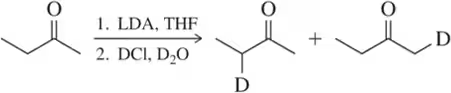
The following are all substitution reactions, two of which we study in later chapters. With no knowledge of mechanism, what would you expect the ratio of products to be for each reaction, based on a random statistical distribution?
(a) Replacing a hydrogen (H) with chlorine (Cl):

Verified step by step guidance
1
Step 1: Identify the type of substitution reaction. In this case, the reaction involves replacing a hydrogen atom (H) with a chlorine atom (Cl). This is a halogenation reaction, specifically chlorination.
Step 2: Determine the number of hydrogens available for substitution in the molecule. Count the hydrogens on each type of carbon (e.g., primary, secondary, tertiary) in the molecule to understand the statistical likelihood of substitution.
Step 3: Recognize that the ratio of products will depend on the number of hydrogens available for substitution at each position. For example, if there are 6 primary hydrogens and 2 secondary hydrogens, the statistical ratio of products would be proportional to these numbers.
Step 4: Assume that the reaction proceeds without any preference for specific hydrogens (i.e., no regioselectivity or stereoselectivity). This means the distribution of products is purely based on the statistical availability of hydrogens.
Step 5: Calculate the expected ratio of products by dividing the number of hydrogens at each position by the total number of hydrogens in the molecule. This gives the statistical probability of substitution at each position.

Verified video answer for a similar problem:

This video solution was recommended by our tutors as helpful for the problem above.
Video duration:
7m
Was this helpful?

Key Concepts

Here are the essential concepts you must grasp in order to answer the question correctly.

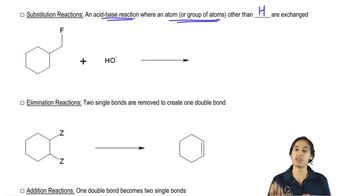
Substitution Reactions

Substitution reactions involve the replacement of one atom or group in a molecule with another atom or group. In organic chemistry, these reactions are common in alkanes and aromatic compounds, where a leaving group is replaced by a nucleophile or electrophile. Understanding the nature of the reactants and the conditions can help predict the products formed.
Recommended video:
Guided course
01:34
Recognizing Substitution Reactions.

Statistical Distribution of Products

In the context of substitution reactions, a statistical distribution refers to the likelihood of different products forming based on the number of available sites for substitution. If multiple identical sites exist, the products will form in ratios that reflect the number of ways each substitution can occur, assuming no preference for any specific site.
Recommended video:
Guided course
11:07
Bridged-Products

Reactivity of Halogens

Halogens, such as chlorine, are highly reactive and can replace hydrogen atoms in organic compounds. The reactivity of halogens varies, with chlorine being a strong electrophile that can engage in substitution reactions. Understanding the reactivity of halogens helps predict the outcome of reactions and the expected ratios of products formed when substituting hydrogen with chlorine.
Recommended video:
Guided course
03:45
Halogenation Mechanism