
Ch. 5 - Chemical Reaction Analysis: Thermodynamics and Kinetics
Mullins - Organic Chemistry: A Learner Centered Approach 1st Edition
Mullins1st EditionOrganic Chemistry: A Learner Centered ApproachISBN: 9780137566471Not the one you use?Change textbook
Chapter 4, Problem 40c

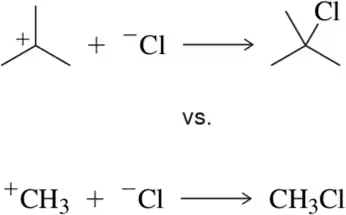
For each pair of reactions, predict which will happen more quickly. [For (c) and (d), the more substituted carbocation is more stable due to hyperconjugation.]
(c) Comparison of two reactions involving carbocations and chloride ions, highlighting stability differences.

Verified step by step guidance
1
Step 1: Analyze the two reactions provided. The first reaction involves a tertiary carbocation reacting with chloride ion, while the second reaction involves a methyl carbocation reacting with chloride ion.
Step 2: Recall the concept of carbocation stability. Tertiary carbocations are more stable than methyl carbocations due to hyperconjugation and inductive effects from surrounding alkyl groups.
Step 3: Understand the role of carbocation stability in reaction rates. A more stable carbocation will form faster and react more quickly because it lowers the activation energy of the reaction.
Step 4: Compare the two reactions. The tertiary carbocation in the first reaction is stabilized by three alkyl groups, whereas the methyl carbocation in the second reaction has no alkyl groups to stabilize it.
Step 5: Conclude that the reaction involving the tertiary carbocation will happen more quickly due to the increased stability provided by hyperconjugation and inductive effects.

Verified video answer for a similar problem:

This video solution was recommended by our tutors as helpful for the problem above.
Video duration:
2m
Was this helpful?

Key Concepts

Here are the essential concepts you must grasp in order to answer the question correctly.

Carbocation Stability

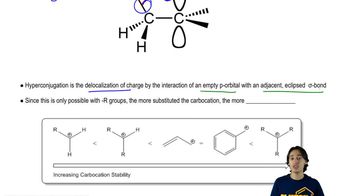
Carbocations are positively charged carbon species that can vary in stability based on their substitution. More substituted carbocations are generally more stable due to the inductive effect and hyperconjugation, where adjacent carbon-hydrogen bonds can donate electron density to the positively charged carbon, stabilizing it. Understanding this concept is crucial for predicting reaction rates and mechanisms in organic chemistry.
Recommended video:
Guided course
05:58
Determining Carbocation Stability

Hyperconjugation

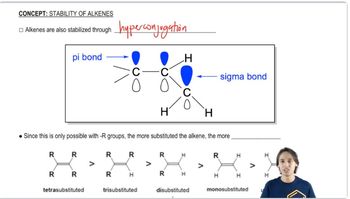
Hyperconjugation is a stabilizing interaction that occurs when the electrons in a sigma bond (usually C-H or C-C) interact with an adjacent empty p-orbital or a positively charged carbon. This interaction helps to delocalize the positive charge in carbocations, thereby increasing their stability. Recognizing the role of hyperconjugation is essential for evaluating the relative rates of reactions involving carbocations.
Recommended video:
Guided course
04:28
Understanding trends of alkene stability.

Base Stability

The stability of bases is a key factor in determining the rate of reactions, particularly in acid-base chemistry. Stronger bases are typically less stable and more reactive, while weaker bases are more stable and less reactive. In the context of the question, understanding the stability of the bases involved in the reactions will help predict which reaction will proceed more quickly based on the relative strengths of the bases.
Recommended video:
Guided course
03:43
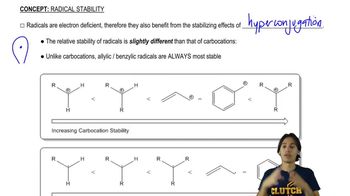
The radical stability trend.