Textbook Question
For each set of reactive intermediates, rank them in order of reactivity (1 = most reactive).
(a)
1
views

 Mullins 1st EditionCh. 5 - Chemical Reaction Analysis: Thermodynamics and KineticsProblem 50d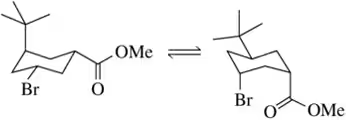
 Verified step by step guidance
 01:05
01:05
 06:27
06:27 02:19
02:19For each set of reactive intermediates, rank them in order of reactivity (1 = most reactive).
(a)
The A value of a substituent on a cyclohexane ring is essentially the ∆G° for a substituent going from the equatorial to the axial position in a chair–chair interconversion. Because most substituents prefer to be in the equatorial position, A values are, by definition, positive numbers. Use the table of A values to calculate ∆G° and Keq for the chair–chair interconversions shown.
(c)
The A value of a substituent on a cyclohexane ring is essentially the ∆G° for a substituent going from the equatorial to the axial position in a chair–chair interconversion. Because most substituents prefer to be in the equatorial position, A values are, by definition, positive numbers. Use the table of A values to calculate ∆G° and Keq for the chair–chair interconversions shown.
(b)
For each set of reactive intermediates, rank them in order of reactivity (1 = most reactive).
(b)
For each set of reactive intermediates, rank them in order of reactivity (1 = most reactive).
(c)
The A value of a substituent on a cyclohexane ring is essentially the ∆G° for a substituent going from the equatorial to the axial position in a chair–chair interconversion. Because most substituents prefer to be in the equatorial position, A values are, by definition, positive numbers. Use the table of A values to calculate ∆G° and Keq for the chair–chair interconversions shown.
(a)