Ch. 5 - Chemical Reaction Analysis: Thermodynamics and Kinetics
Mullins - Organic Chemistry: A Learner Centered Approach 1st Edition
Mullins1st EditionOrganic Chemistry: A Learner Centered ApproachISBN: 9780137566471Not the one you use?Change textbook
Chapter 4, Problem 50b

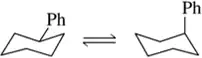
The A value of a substituent on a cyclohexane ring is essentially the ∆G° for a substituent going from the equatorial to the axial position in a chair–chair interconversion. Because most substituents prefer to be in the equatorial position, A values are, by definition, positive numbers. Use the table of A values to calculate ∆G° and Keq for the chair–chair interconversions shown.
(b) Cyclohexane chair conformations showing a phenyl substituent shifting from equatorial to axial position.

Verified step by step guidance
1
Step 1: Understand the concept of A values. A values represent the free energy difference (∆G°) between the equatorial and axial positions of a substituent on a cyclohexane ring during a chair–chair interconversion. Positive A values indicate that the equatorial position is favored.
Step 2: Recall the relationship between ∆G° and the equilibrium constant (K_eq). The equation is given by: ∆G°=-RTlnK_eq, where R is the gas constant (8.314 J/mol·K), T is the temperature in Kelvin, and K_eq is the equilibrium constant.
Step 3: Use the provided table of A values to find the ∆G° for the substituent in question. The A value directly corresponds to the ∆G° for the equatorial-to-axial transition.
Step 4: Rearrange the equation to solve for K_eq: K_eq=e-∆G°/RT. Substitute the values for ∆G°, R, and T into the equation to calculate K_eq.
Step 5: Interpret the results. If K_eq > 1, the equatorial position is strongly favored. If K_eq < 1, the axial position is favored. Use the calculated values to understand the preference of the substituent in the chair–chair interconversion.

Verified video answer for a similar problem:

This video solution was recommended by our tutors as helpful for the problem above.
Video duration:
3m
Was this helpful?

Key Concepts

Here are the essential concepts you must grasp in order to answer the question correctly.

Chair Conformation of Cyclohexane

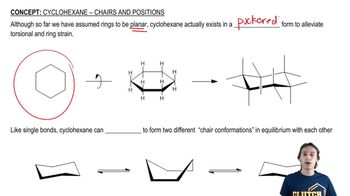
The chair conformation is the most stable arrangement of cyclohexane, minimizing steric strain and torsional strain. In this conformation, carbon atoms adopt a staggered arrangement, allowing substituents to occupy either equatorial or axial positions. Equatorial substituents are generally more stable due to reduced steric hindrance with adjacent hydrogen atoms, making understanding this conformation crucial for analyzing substituent effects.
Recommended video:
Guided course
01:05
What is a chair conformation?

A Values and Free Energy Change (∆G°)

A values represent the free energy change (∆G°) associated with the transition of a substituent from the equatorial to the axial position in cyclohexane. Positive A values indicate that substituents favor the equatorial position due to lower energy and greater stability. Understanding A values is essential for calculating the equilibrium constant (K_eq) for chair-chair interconversions, as they directly influence the stability of different conformations.
Recommended video:
Guided course
06:07
Introduction to free energy diagrams.

Equilibrium Constant (K_eq)

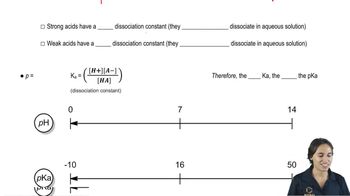
The equilibrium constant (K_eq) quantifies the ratio of the concentrations of products to reactants at equilibrium for a reversible reaction. In the context of chair-chair interconversions, K_eq can be calculated using the relationship K_eq = e^(-∆G°/RT), where R is the gas constant and T is the temperature in Kelvin. This concept is vital for understanding the relative stability of different conformations and predicting the favored position of substituents in cyclohexane.
Recommended video:
Guided course
02:19
The relationship between equilibrium constant and pKa.
Related Practice
Textbook Question

For each set of reactive intermediates, rank them in order of reactivity (1 = most reactive).

(a)

1
views

Textbook Question

The A value of a substituent on a cyclohexane ring is essentially the ∆G° for a substituent going from the equatorial to the axial position in a chair–chair interconversion. Because most substituents prefer to be in the equatorial position, A values are, by definition, positive numbers. Use the table of A values to calculate ∆G° and Keq for the chair–chair interconversions shown.

(c)

1
views
Textbook Question

For each of the following reactions, identify the bonds that are broken and formed. Be sure to indicate whether the bond that is broken is a σ bond or a π bond.

(e)

1
views
Textbook Question

The A value of a substituent on a cyclohexane ring is essentially the ∆G° for a substituent going from the equatorial to the axial position in a chair–chair interconversion. Because most substituents prefer to be in the equatorial position, A values are, by definition, positive numbers. Use the table of A values to calculate ∆G° and Keq for the chair–chair interconversions shown.

(d)

Textbook Question

For each of the following reactions, identify the bonds that are broken and formed. Be sure to indicate whether the bond that is broken is a σ bond or a π bond.

(c)

2
views
Textbook Question

The A value of a substituent on a cyclohexane ring is essentially the ∆G° for a substituent going from the equatorial to the axial position in a chair–chair interconversion. Because most substituents prefer to be in the equatorial position, A values are, by definition, positive numbers. Use the table of A values to calculate ∆G° and Keq for the chair–chair interconversions shown.

(a)

1
views