
Ch. 5 - Chemical Reaction Analysis: Thermodynamics and Kinetics
Mullins - Organic Chemistry: A Learner Centered Approach 1st Edition
Mullins1st EditionOrganic Chemistry: A Learner Centered ApproachISBN: 9780137566471Not the one you use?Change textbook
Chapter 4, Problem 52e

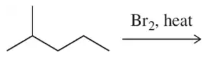
Predict the product(s) of the following halogenation reactions. Only one equivalent of the halogen is used in each case. If the reaction proceeds selectively, indicate this by only drawing the major product. If the reaction is not selective, draw all possible products.
(e)

Verified step by step guidance
1
Step 1: Recognize that the reaction involves bromination under heat, which suggests a radical halogenation mechanism. Bromine (Br₂) reacts selectively with the most stable radical intermediate.
Step 2: Identify the structure of the starting alkane. The molecule shown is 2-methylpentane, which has primary, secondary, and tertiary hydrogens available for abstraction.
Step 3: Determine the stability of the possible radicals formed by hydrogen abstraction. Tertiary radicals are the most stable, followed by secondary, and then primary radicals.
Step 4: Predict the major product based on the selective nature of bromination. Bromine will preferentially abstract a hydrogen from the tertiary carbon, leading to the formation of the major product where bromine is attached to the tertiary carbon.
Step 5: If the reaction is not completely selective, consider the possibility of minor products formed by bromination at secondary or primary carbons. Draw all possible products, but emphasize the major product formed at the tertiary position.

Verified video answer for a similar problem:

This video solution was recommended by our tutors as helpful for the problem above.
Was this helpful?

Key Concepts

Here are the essential concepts you must grasp in order to answer the question correctly.

Halogenation Reactions

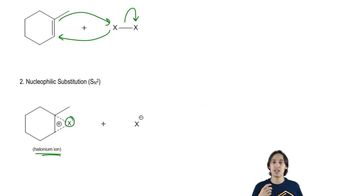
Halogenation refers to the chemical reaction where a halogen atom (such as chlorine or bromine) is introduced into a compound, typically an alkane or alkene. This process can occur through radical mechanisms or electrophilic addition, depending on the substrate and conditions. Understanding the mechanism is crucial for predicting the products formed during the reaction.
Recommended video:
Guided course
03:45
Halogenation Mechanism

Selectivity in Reactions

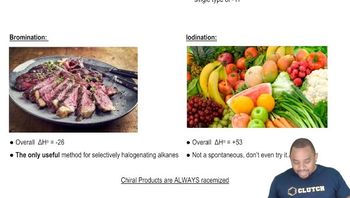
Selectivity in organic reactions refers to the preference of a reaction pathway that leads to the formation of a major product over other possible products. Factors influencing selectivity include the stability of intermediates, steric hindrance, and the nature of the reactants. Recognizing whether a reaction is selective helps in accurately predicting the predominant product.
Recommended video:
Guided course
10:08
Radical selectivity:Alcoholics Anonymous Version

Product Prediction

Product prediction involves determining the expected outcomes of a chemical reaction based on the reactants and reaction conditions. This includes identifying all possible products, especially in cases where multiple products can form due to non-selective reactions. A thorough understanding of functional groups and reaction mechanisms is essential for making accurate predictions.
Recommended video:
Guided course
03:13
Predict the Products