
Ch. 5 - Chemical Reaction Analysis: Thermodynamics and Kinetics
Mullins - Organic Chemistry: A Learner Centered Approach 1st Edition
Mullins1st EditionOrganic Chemistry: A Learner Centered ApproachISBN: 9780137566471Not the one you use?Change textbook
Chapter 4, Problem 54a

Draw a reaction coordinate diagram, making sure to label reactants (R), products (P), intermediates (I), transition states (‡), activation energies ( Ea) , and ∆G°, for each of the following.
(a) an exothermic, one-step reaction

Verified step by step guidance
1
Start by understanding the key components of a reaction coordinate diagram. The x-axis represents the reaction progress, while the y-axis represents the potential energy of the system.
Since the reaction is exothermic, the energy of the products (P) will be lower than the energy of the reactants (R). This indicates that energy is released during the reaction, and the overall change in Gibbs free energy (∆G°) will be negative.
For a one-step reaction, there will be no intermediates (I). The reaction will proceed directly from reactants (R) to products (P) through a single transition state (‡). The transition state represents the highest energy point along the reaction pathway.
Label the activation energy (Eₐ) as the energy difference between the reactants (R) and the transition state (‡). This is the energy barrier that must be overcome for the reaction to proceed.
Finally, label ∆G° as the energy difference between the reactants (R) and the products (P). Ensure that the diagram clearly shows the relative energy levels of R, ‡, and P, with P being at a lower energy level than R to reflect the exothermic nature of the reaction.

Verified video answer for a similar problem:

This video solution was recommended by our tutors as helpful for the problem above.
Video duration:
3m
Was this helpful?

Key Concepts

Here are the essential concepts you must grasp in order to answer the question correctly.

Reaction Coordinate Diagram

A reaction coordinate diagram is a graphical representation that illustrates the energy changes during a chemical reaction. The x-axis typically represents the progress of the reaction, while the y-axis shows the energy of the system. Key features include the energy levels of reactants, products, intermediates, and transition states, which help visualize the energy barriers and overall energy change of the reaction.
Recommended video:
Guided course
05:02
Coordination Complexes

Exothermic Reaction

An exothermic reaction is a type of chemical reaction that releases energy, usually in the form of heat, to the surroundings. In a reaction coordinate diagram, this is depicted by the products being at a lower energy level than the reactants. The difference in energy between the reactants and products is represented as a negative change in Gibbs free energy (∆G°), indicating that the reaction is energetically favorable.
Recommended video:
Guided course
05:09
Heck Reaction

Activation Energy (Eₐ)

Activation energy (Eₐ) is the minimum energy required for a reaction to occur, representing the energy barrier that must be overcome for reactants to transform into products. In a reaction coordinate diagram, it is illustrated as the energy difference between the reactants and the highest point of the transition state. Understanding activation energy is crucial for predicting reaction rates and the feasibility of a reaction.
Recommended video:
Guided course
06:07
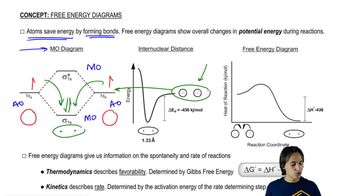
Introduction to free energy diagrams.
Related Practice
Textbook Question

Predict the product(s) of the following halogenation reactions. Only one equivalent of the halogen is used in each case. If the reaction proceeds selectively, indicate this by only drawing the major product. If the reaction is not selective, draw all possible products.

(e)

1
views
Textbook Question

For each of the reaction coordinate diagrams shown, (i) indicate the number of steps in the reaction, (ii) label the intermediates, (iii) identify the rate-determining step, and (iv) tell whether Keq is greater than, less than, or equal to zero.

(a)

1
views
Textbook Question

Predict the product(s) of the following halogenation reactions. Only one equivalent of the halogen is used in each case. If the reaction proceeds selectively, indicate this by only drawing the major product. If the reaction is not selective, draw all possible products.

(f)

1
views
Textbook Question

Draw a reaction coordinate diagram, making sure to label reactants (R), products (P), intermediates (I), transition states (‡), activation energies ( Ea) , and ∆G°, for each of the following.

(c) a slightly endothermic, three-step reaction where the first step is rate-determining

2
views
Textbook Question

Draw a reaction coordinate diagram, making sure to label reactants (R), products (P), intermediates (I), transition states (‡), activation energies ( Ea) , and ∆G°, for each of the following.

(b) an exothermic, two-step reaction where the second step is rate-determining

1
views
Textbook Question

Draw a reaction coordinate diagram, making sure to label reactants (R), products (P), intermediates (I), transition states (‡), activation energies ( Ea) , and ∆G°, for each of the following.

(d) a slightly exothermic, three-step reaction where the third step is rate-determining.

1
views